|
 |
Hi, y’all. Welcome back to The Opposition. A lot of the Democratic party’s focus has understandably been on competitive House and Senate races coming up next year. But there’s also a slate of gubernatorial races in 2026—races that are chronically underappreciated but deeply important. Today’s newsletter spotlights one of the more intriguing ones: a rematch between a senator known better for his middling record as a football coach than his policy chops as a lawmaker, and a trailblazing civil rights attorney who defied the political odds before. Naturally, this being the Deep South, the ex-coach is wildly favored. Still, it’s one to watch.
Today’s full newsletter is for Bulwark+ members. If you’re not yet a member, consider signing up today. You’ll get your first 30 days free.
If you do sign up, not only can you read today’s newsletter, but you can jump in the comments and let me know what races, candidates, elected officials, etc. you’d like to read about here. It’s crazy to think that we’re less than three months out from the first primaries of the 2026 cycle. We’d love to have you aboard for the whole wild ride of the next year.
–Lauren
If Any Dem Can Be Governor of Alabama, It’s This Guy. It Still May Take a Miracle.
Running against Tommy Tuberville may not seem like a major challenge. But it is in the deep-red South.
|

| |||||||||||||||


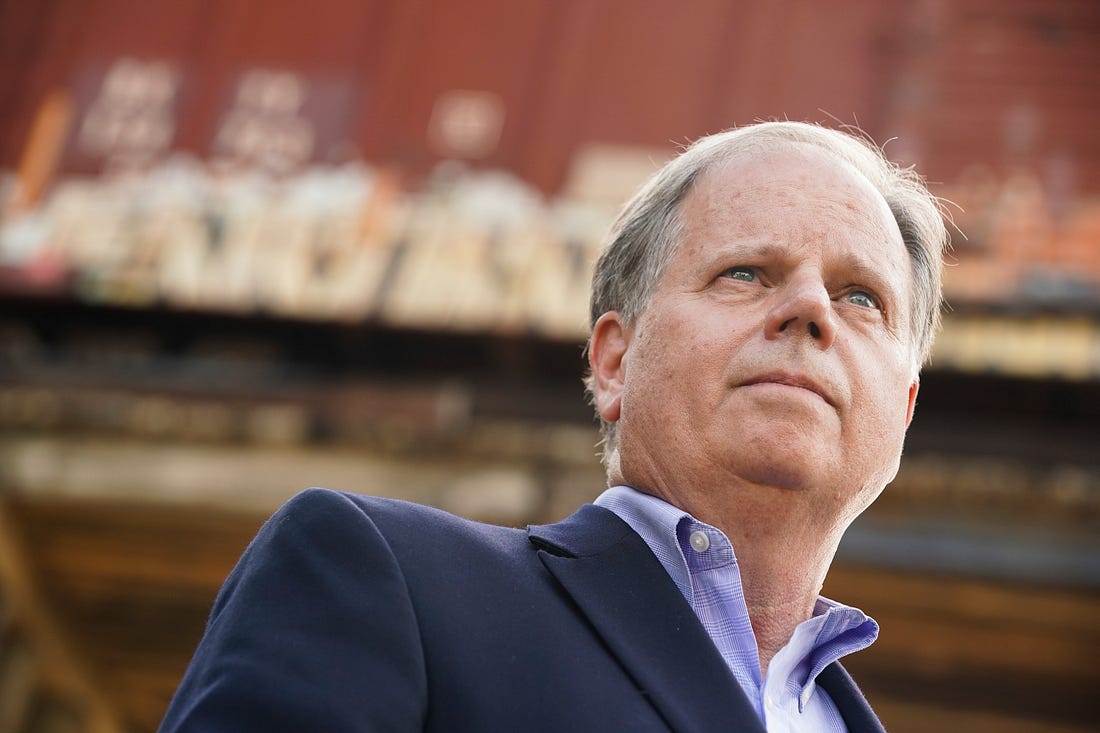 |
IN 2017, DOUG JONES DID THE UNTHINKABLE. He won a special election in Alabama for the U.S. Senate, defeating Republican Roy Moore by half a percentage point. At the time, it shocked the political system. Democrats were believed to be extinct in the Deep South.
But there were always some real caveats around the win, as much as it served as an early sign that a blue wave was coming in the 2018 midterms. Moore was a uniquely bad candidate (such is the case when one faces multiple accusations of sexual assault and misconduct involving women as young as 14). Beyond that, Jones’s Senate career proved fruitful but short-lived. In 2020, he lost his re-election by 20 percentage points to Tommy Tuberville, the former Auburn football coach—a man not known as, exactly, a political or policy whiz.
Although Joe Biden briefly considered nominating Jones to be attorney general, he chose Merrick Garland instead. History can be the judge of that. Jones went back home to Alabama where he remained close with the Biden White House and continued advising the party from his perch outside of Birmingham. For a minute, it seemed like electoral politics might be in his past.
But that changed on Friday when Jones, famed for his late-1990s role in prosecuting Ku Klux Klan members who in 1963 had killed four girls in a black church bombing, officially kicked off his race for governor. In doing so, he set up for another faceoff with Tuberville, who announced his gubernatorial bid in May.
Despite indications that 2026 will, like 2018, be a favorable year for Democrats, this is still the Deep South we’re talking about. The last time Alabama elected a Democrat for governor was 1998. But other Democrats like John Bel Edwards and Andy Beshear have proven that good candidates can turn gubernatorial mansions blue, even in the reddest of states.
I caught up with Jones on Friday before his campaign kickoff to chat about his path to victory. He was frank about the fact that Tuberville is favored and how the national party’s image and positions hurt his re-election bid in 2020. But he outlined a formula, one that rested on the long-elusive goal of winning back rural voters. Along the way, we addressed his feelings on being passed over as attorney general. Our conversation has been edited for length and clarity.
LAUREN EGAN: You won the 2017 Senate race because you ran against Roy Moore, who was an alleged sex predator. You can say a lot of negative things about Tommy Tuberville, but he’s not a predator. So, how does this end well for you?
DOUG JONES: Moore was certainly a flawed candidate but Tommy Tuberville is just as flawed, just in a different way. He’s now had five years as a U.S. senator, where he’s really not done a damn thing to help the people of Alabama.
I know we’re an underdog, and that’s okay. But you know what? Those two PSC [Public Service Commission] candidates in Georgia were underdogs, those legislators in Mississippi were underdogs.¹
EGAN: This is not your first time running against Tuberville. What did you learn from running against him last time?
JONES: The biggest problem last time ...
Join The Bulwark to unlock the rest.
Become a paying member of The Bulwark to get access to this post and other subscriber-only content.