As 2025 draws to a close, both major political parties have their attention trained on next year’s midterm elections, and one Illinois congresswoman is working the phones to identify and counsel candidates she hopes can erase Republicans’ slim House majority.
Welcome to this week’s edition of AP Ground Game. |
Policy changes, but facts endure. AP delivers accurate, fact-based journalism to keep the world informed in every administration. Support independent reporting today. Donate. |
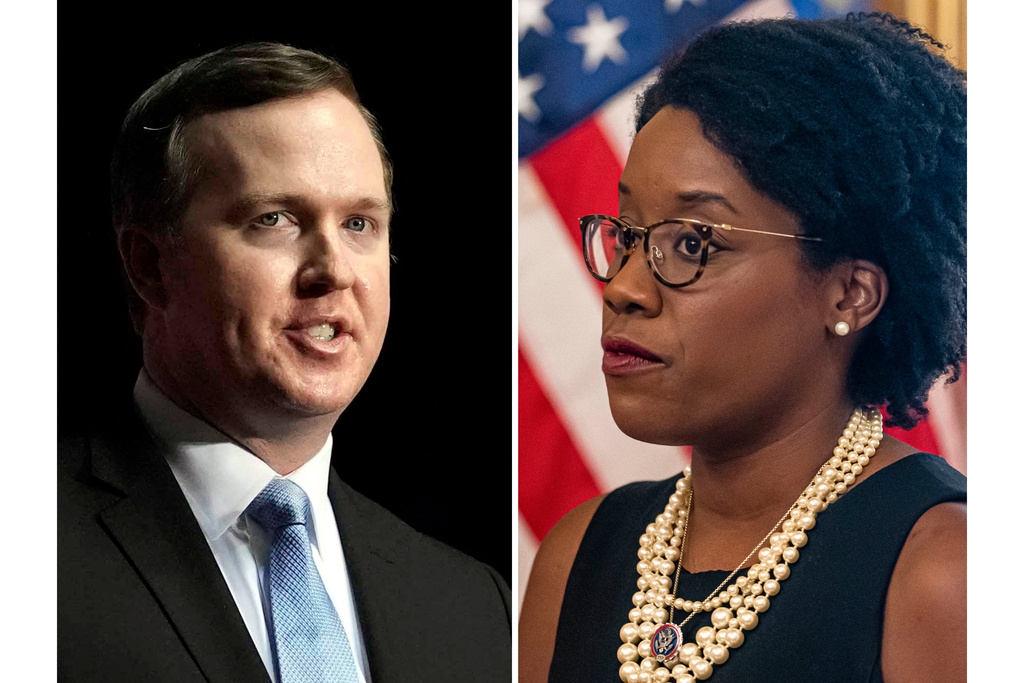
This combination photo shows Brian Jack, left, speaking at a campaign rally, March 9, 2024, in Rome, Ga. and Lauren Underwood speaking with reporters, Aug. 9, 2022, in Washington. (AP Photo/Mike Stewart, Nathan Howard) |
Meet the Democrat trying to make another blue wave happen |
Even though Republican Brian Jack is only a first-term congressman, he has become a regular in the Oval Office these days. As the top recruiter for his party’s House campaign team, the Georgia native is often reviewing polling and biographies of potential candidates with President Donald Trump.
Lauren Underwood, an Illinois congresswoman who does similar work for Democrats, has no such West Wing invitation. She is at the other end of Pennsylvania Avenue working the phones to identify and counsel candidates she hopes can erase Republicans’ slim House majority in November’s midterm elections.
Although they have little in common, both lawmakers were forged by the lessons of 2018, when Democrats flipped dozens of Republican-held seats to turn the rest of Trump’s first term into a political crucible. Underwood won her race that year, and Jack became responsible for dealing with the fallout when he became White House political director a few months later. Underwood wants a repeat in 2026, and Jack is trying to stand in her way. Read more. |
|
|
Of note:
It’s routine for a president’s party to lose ground in Congress during the first midterms after winning the White House. Trump, however, is in the rare position to test that historical trend with a second, nonconsecutive presidency.
Neither party has released its list of favored candidates in targeted seats. But Jack said Oval Office discussions with Trump focus on who can align with the White House in a way that can win. |
|
|
States defend congressional gerrymandering as ‘fair’ |
When Indiana adopted new U.S. House districts four years ago, Republican legislative leaders lauded them as “fair maps” reflecting the state's communities. But when Gov. Mike Braun recently tried to redraw the lines to help Republicans gain more power, implored lawmakers to “vote for fair maps.” What changed? The definition of “fair.”
As states undertake mid-decade redistricting instigated by Trump, Republicans and Democrats are using a tit-for-tat definition of fairness to justify districts that split communities in an attempt to send politically lopsided delegations to Congress. They argue it’s fair because other states have done the same — and necessary to maintain a partisan balance in the House of Representatives that resembles the national political divide.
Although Indiana state senators rejected a new map backed by Trump and Braun that could have helped Republicans win all nine of the state’s congressional seats, districts have already been redrawn in Texas, California, Missouri, North Carolina and Ohio. Other states could consider changes before the 2026 midterms that will determine control of Congress. Read more.
|
|
|
Of note:
By some national measurements, the U.S. House already is politically fair. The 220-215 majority that Republicans won over Democrats in the 2024 elections almost perfectly aligns with the share of the vote the two parties received in districts across the country, according to an Associated Press analysis. But that overall balance belies an imbalance that exists in many states. Even before this year's redistricting, the number of states with congressional districts tilted toward one party or another was higher than at any point in at least a decade, the AP analysis found. |
|
|
Ruben Gallego emerges as key Democratic figure in Latino voter outreach |
Democratic Sen. Ruben Gallego of Arizona is emerging as a crucial surrogate for a party desperately seeking to win back the Latino support that slipped in 2024 with Trump’s election. Stumping across New Jersey, Virginia and Florida for Democrats who went on to win their elections, Gallego is flexing his muscle as a rising star for the party — while also laying the groundwork for a 2028 presidential run.
In the 2024 presidential election, Trump made inroads in with Latino voters in some areas. But results from recent elections have shown signs that key voting groups, including Hispanics, were shifting away from Republicans. And in Miami, Eileen Higgins became the first Democratic mayor to be elected in nearly 30 years.
“We’re going to places where there’s big Latino populations,” Gallego told The Associated Press in Miami. “Obviously, they swung a little too much in our opinion toward Trump last time, and we wanna talk to Democrats and we wanna talk to Latinos, we wanna talk to candidates about how to get that population back into our corner.” Read more.
|
|
|
Of note:
Gallego himself outperformed Vice President Kamala Harris in 2024, when he won a Senate seat in Arizona by more than 2 points, while Trump carried the state by nearly 6 points. He gives the Republican president credit for his border security measures and, at times, praises Trump’s blunt style for not overthinking economic proposals when crafting his populist messaging. |
|
|
President Donald Trump walks onto the field with Lt. Gen. Steven Gilland, Superintendent of the U.S. Military Academy at West Point, left, before the start of the 126th Army-Navy NCAA college football game at M&T Bank Stadium, Sat |
|
|
|