|
 |




It was a weekend of horrible news, with appalling outbreaks of violence both here in America and abroad. We’re praying for all those affected by the attacks at Brown University and on the Jewish community in Australia. It’s not a happy Monday.
 |
Numbness in Providence
by Hannah Yoest
PROVIDENCE, RHODE ISLAND—The doors are not the problem. In the aftermath of the mass school shooting at Brown University on Saturday, in which two died and nine were injured, many have started to call for the school to follow Columbia and Yale in completely locking down and gating the campus. This willful avoidance of the real issue says a lot about how we deal with these tragedies. The continued failure to address gun violence has engendered learned helplessness. We treat the Second Amendment—and a questionably broad reading of it—like an immutable commandment rather than a matter of policy.
The Rhode Island School of Design, where I’m a graduate student, shares much of Brown’s campus. The security measures in place are already extensive. Most buildings require you to swipe an access badge to get through multiple locked doors.
In a press conference Sunday morning at the local fire station, one reporter mentioned the two Brown students who were already survivors of a mass shooting from their time in high school. She pressed Providence Mayor Brett Smiley, “What do you feel needs to be done to keep this from happening, to stop that cycle of violence?”
Smiley declined to address her concern directly, admonishing her that, so soon after the murders, the time for advocacy was not yet right. But he recalled what one student in the hospital who “showed tremendous courage” told him: ”You know that active-shooter drill they made me do in high school actually helped me in the moment.”
That observation, Smiley said, “provided me hope, and was so sad. We shouldn’t have to do active-shooter drills, but it helped, and the reason it helped and the reason we do these drills is because [mass shootings are] damn frequent.”
Active-shooter drills are a way of hardening our softest targets. They’re also a way of hardening our hearts, accepting that to be a student in America is to be a victim-in-waiting.
After so many years and so many young deaths, it’s not hard to see why America has become such a low-trust society. But it’s jarring to be treated as if reporting on a mass shooting is to be an accomplice after the fact. Walking around campus and at the hospital, asking people if they’d be willing to share their experience, I was met with a range of suspicion, and even hostility.
There was a time when the families and friends of victims—and the survivors—wanted their stories told. Not anymore. Maybe in past years they knew the power of their experiences, but since then they’ve seen their impotence.
The problem is threefold: First, after Sandy Hook, we saw the families of victims targeted, smeared, and plagued by lies and conspiracy theories promoted by charlatans posing as “journalists,” with little recourse but the glacial judicial system.
In the dozen years since, things have gotten worse. At the top, we have a leader who has made lying the foundation of his movement while attacking the media at every turn, weakening a once-robust force for accountability.
And on the opposite end of the spectrum, there is a streak of political correctness, especially among people my age or younger, whose sensibilities about media gatekeeping and the morality of telling someone else’s story is, to borrow a term, “problematic.” The net effect is that no one seems to believe in the power of the truth anymore.
Those few who were willing to open up showed grace in the wake of the tragedy. I spoke with a pair of sophomores on the main quad who asked to not be named because their parents had warned them never to trust the press. They were building a snowman.
“It’s a terrible situation, and we’re all shocked,” one said, “Brown, though, is the ‘Happy Ivy.’ It’s in our nature to be out on the green here doing fun things, but it’s obviously not the same now.”
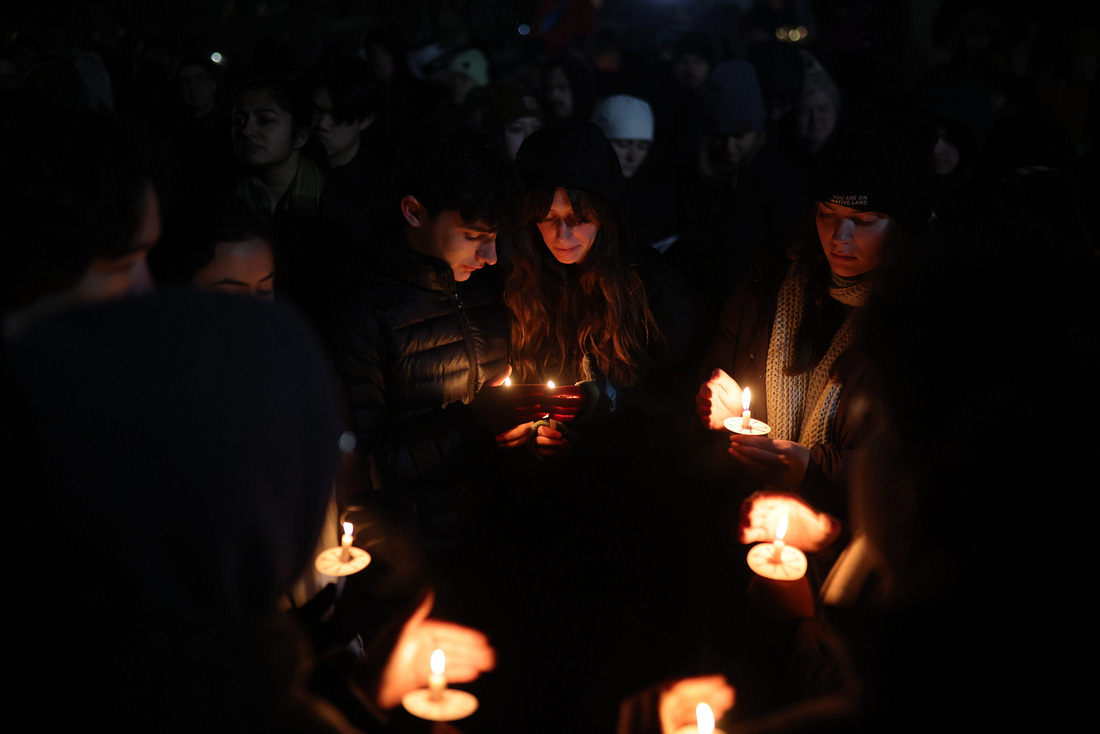
Later in the evening, at a vigil held by the Providence City Council in lieu of a planned holiday celebration, more than 200 people gathered to light candles and mourn together. The Red Cross provided hot drinks and blankets as snow fell on the crowd. Two other sophomores, who had known one of the victims, encapsulated the feeling of helplessness attendant to grief: “Vigils always help,” one said.
The Murder of Innocents
by William Kristol
Things fall apart; the centre cannot hold;
Mere anarchy is loosed upon the world,
The blood-dimmed tide is loosed, and everywhere
The ceremony of innocence is drowned.
—William Butler Yeats, “The Second Coming”
“The ceremony of innocence is drowned.”
The cascade of murders of innocents this past weekend—students preparing for final exams at Brown, Jews celebrating the festival of Hanukkah in Sydney, Rob and Michele Reiner in Los Angeles—hit home for me, as I imagine it did for many of us, with particular force.
And so this morning, though I’d jotted down notes last night on several possible topics for this newsletter, I find I don’t really want to address any of them yet. I’m not quite ready to move on.
Mind you, it’s not that I have any great insights to share on the terrible events of the past weekend. It’s not as if I have compelling or comforting words to offer in the face of these tragedies.
And it’s not as if I claim especially close connections here. I’ve been friendly with Brown students and faculty, and I very much