|



Tinkering with prompts can only get you so far. (Sponsored)
 |
Most companies get stuck tinkering with prompts and wonder why their agents fail to deliver dependable results. This guide from You.com breaks down the evolution of agent management, revealing the five stages for building a successful AI agent and why most organizations haven’t gotten there yet.
In this guide, you’ll learn:
Why prompts alone aren’t enough and how context and metadata unlock reliable agent automation
Four essential ways to calculate ROI, plus when and how to use each metric
Real-world challenges at each stage of agent management and how to avoid them
When we first interact with large language models, the experience is straightforward. We type a prompt, the model generates a response, and the interaction ends.
This single-turn approach works well for simple questions or basic content generation, but it quickly reveals its limitations when we tackle more complex tasks. Imagine asking an AI to analyze market trends, create a comprehensive report, and provide actionable recommendations. A single response, no matter how well-crafted, often falls short because it lacks the opportunity to gather additional information, reflect on its reasoning, or refine its output based on feedback.
This is where agentic workflows come into play.
Rather than treating AI interactions as one-and-done transactions, agentic workflows introduce iterative processes, tool integration, and structured problem-solving approaches. These workflows transform language models from sophisticated text generators into capable agents that can break down complex problems, adapt their strategies, and produce higher-quality results. The difference is similar to comparing a quick sketch to a carefully refined painting. Both have their place, but when quality and reliability matter, the iterative approach wins.
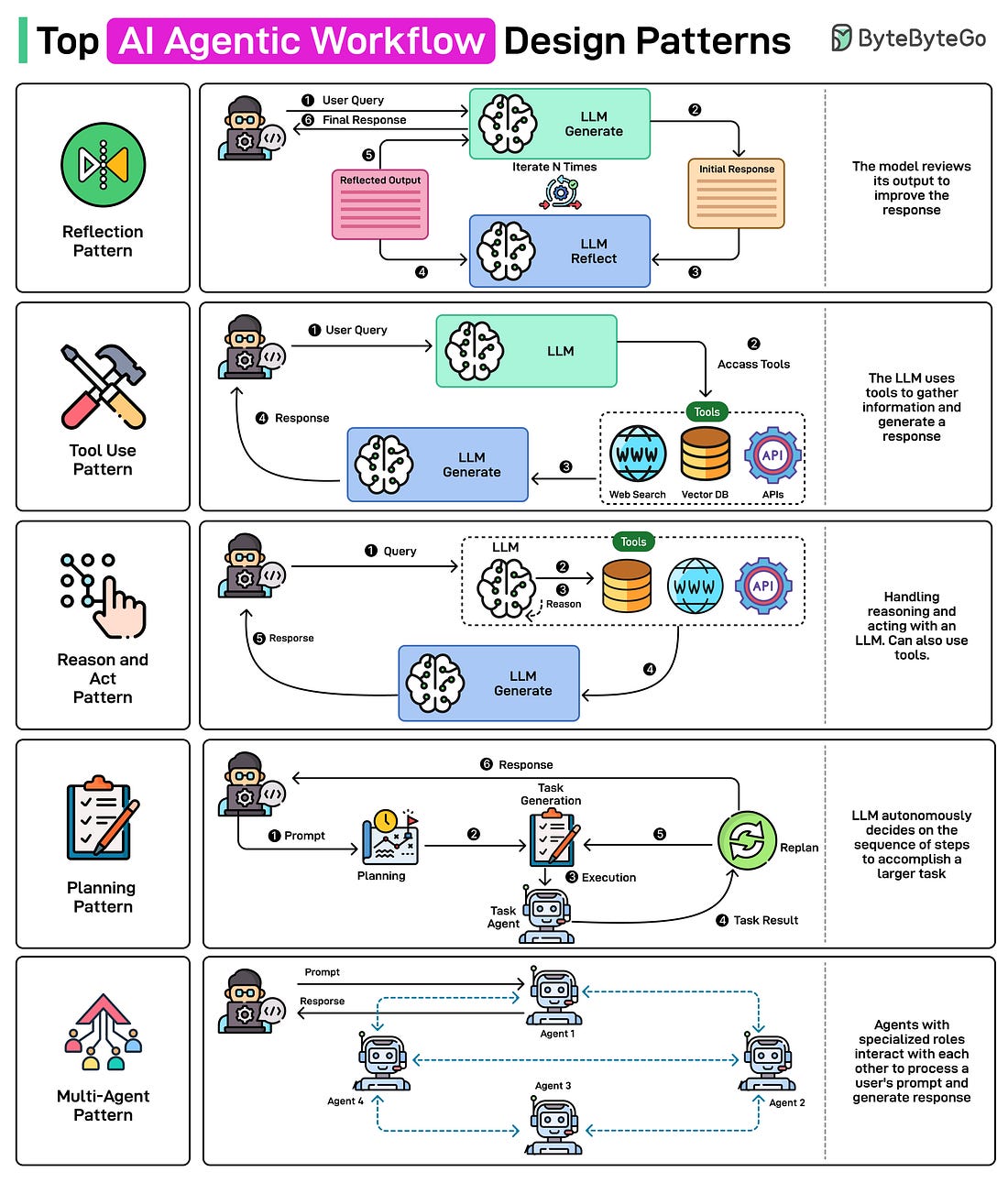
In this article, we will look at the most popular agentic workflow patterns and how they work.
 |
Understanding Agentic Workflows
An agentic workflow doesn’t just respond to a single instruction. Instead, it operates with a degree of autonomy, making decisions about how to approach a task, what steps to take, and how to adapt based on what it discovers along the way. This represents a fundamental shift in how we think about using AI systems.
Consider the difference between asking a basic chatbot and an agentic system to help write a research report. The basic chatbot receives our request and generates a report based on its training data, delivering whatever it produces in one response. An agentic system, however, might first search the web for current information on the topic, then organize the findings into themes, draft sections of the report, review each section for accuracy and coherence, revise weak areas, and finally compile everything into a polished document. Each of these steps might involve multiple sub-steps, decisions about which tools to use, and adaptations based on what the agent discovers.
What makes workflows truly agentic are the iteration and feedback loops built into the process. Instead of generating output in a single pass, agentic workflows involve cycles where the agent takes an action, observes the result, and uses that observation to inform the next action. This mirrors how humans actually solve complex problems. We rarely figure everything out up front and execute a perfect plan. Instead, we try something, see what happens, learn from the result, and adjust our approach. Agentic workflows bring this same adaptive, iterative quality to AI systems.
The Five Essential Agentic Workflow Patterns
Let us now look at five essential agentic workflow patterns:
Reflection Pattern: The Self-Improving Agent
At its core, reflection is about having an agent review and critique its own work, then revise based on that critique. This simple idea improves output quality because it introduces an iterative refinement process that catches errors, identifies weaknesses, and enhances strengths.
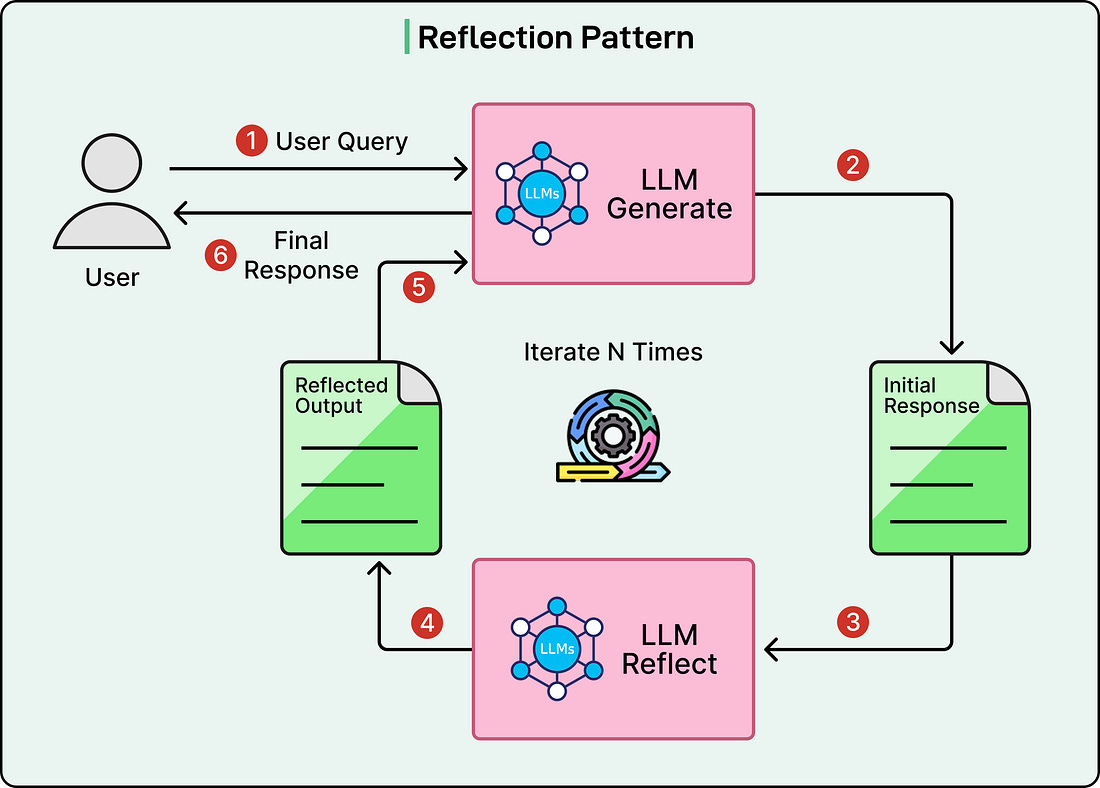
Here’s how the reflection cycle works in practice.
The agent first generates an initial output based on the task or prompt it receives.
Then, instead of immediately presenting this output as final, the agent switches into critique mode. It examines what it just produced, looking for problems, inconsistencies, areas that lack clarity, or opportunities for improvement. This critique becomes the basis for revision.
The agent generates an improved version that addresses the issues it identified. Depending on the implementation, this cycle might repeat multiple times, with each iteration refining the output further.
See the diagram below:
 |
The power of reflection becomes even more apparent when we specialize in the type of critique being performed. Some examples are as follows:
An agent might reflect specifically on accuracy, checking whether the facts and claims it made are correct and well-supported.
Alternatively, reflection might focus on clarity, asking whether someone unfamiliar with the topic would understand the explanation.
For creative writing, reflection might evaluate tone, ensuring the voice matches the intended style and audience.
For code generation, reflection could focus on identifying bugs, security vulnerabilities, or opportunities to optimize performance.
The