At year’s end, Electronic Arts (EA) going private and Disney partnering with OpenAI represent opposite bets on AI’s future in media. Only one will prove right about what is actually possible for shareholders and consumers when AI disrupts everything.
When power laws govern content consumption, can you deliver growth, shareholder value, and consumer delight simultaneously? Or do public market constraints force you to choose which goals are actually achievable?
EA’s answer: All three are possible, but not as a public company. Three months ago, EA announced it had agreed to be acquired by an investor consortium led by Saudi Arabia’s Public Investment Fund, Silver Lake, and Affinity Partners for $55 billion. The company is going private to pursue AI-driven growth and consumer innovation without quarterly earnings pressure.
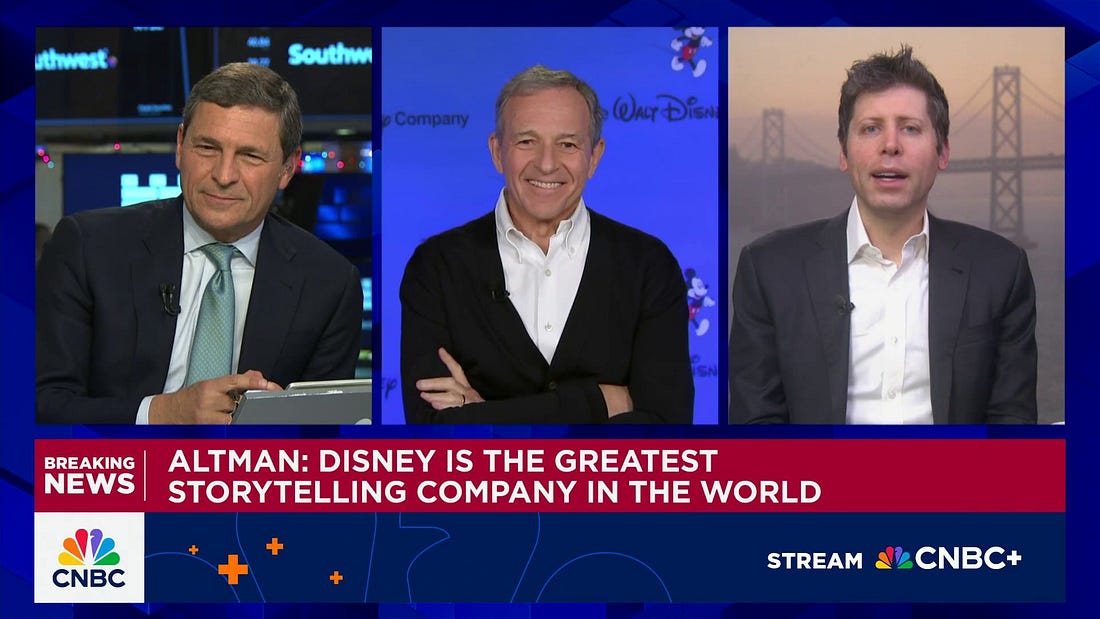
Disney’s answer: As a public company at $200 billion market cap with no exit option, only shareholder value is reliably achievable. So Disney announced its OpenAI partnership last week—framed as innovation and transformation with the licensing of 200 characters to Sora. However, the partnership is fundamentally about operational efficiencies and cost reduction.
The fact that EA is able to bet on all three while Disney can only solve for one is crucial to understanding how the market will evolve in 2026 and beyond.