|
 |
Good afternoon, Press Pass readers. I hope our Jewish readers are having a great Hanukkah so far, and for those about to celebrate Christmas, my hope is for you to have smooth flights, few delays, and un-sweaty seatmates. While waiting at your gate, leave RFK Jr. and his pull-up bar alone—read The Bulwark instead. Upgrade your membership to a Bulwark+ subscription at the link below, and you’ll always have something to do instead of working out at the airport.
Today’s edition offers a preview of the coming year on Capitol Hill, specifically as it relates to House Speaker Mike Johnson’s growing inability to control what type of legislation is actually making it to the floor. The rarely used discharge petition—a tool to force a vote on typically minority-driven priorities—isn’t so rarely used anymore: It’s being downright normalized as one tactic among many for a growing number of aggrieved Republicans lawmakers. In 2026, many more discharge petitions are set to take shape, and they could do much to disrupt the easier-going (some would say lazier) schedule normally planned for election years.
In addition, Sen. Mike Lee (R-Utah) has continued to crawl down his online rabbit hole, mocking the victims of a terrorist attack and spreading more nonsense to his many followers. I am proposing a Mike Lee Watch over the holidays and am volunteering to keep an eye on his slop-filled feed so others can do normal things instead. Lastly, why is the Trump administration going after a nun in Texas? All that and more than you probably want, below.
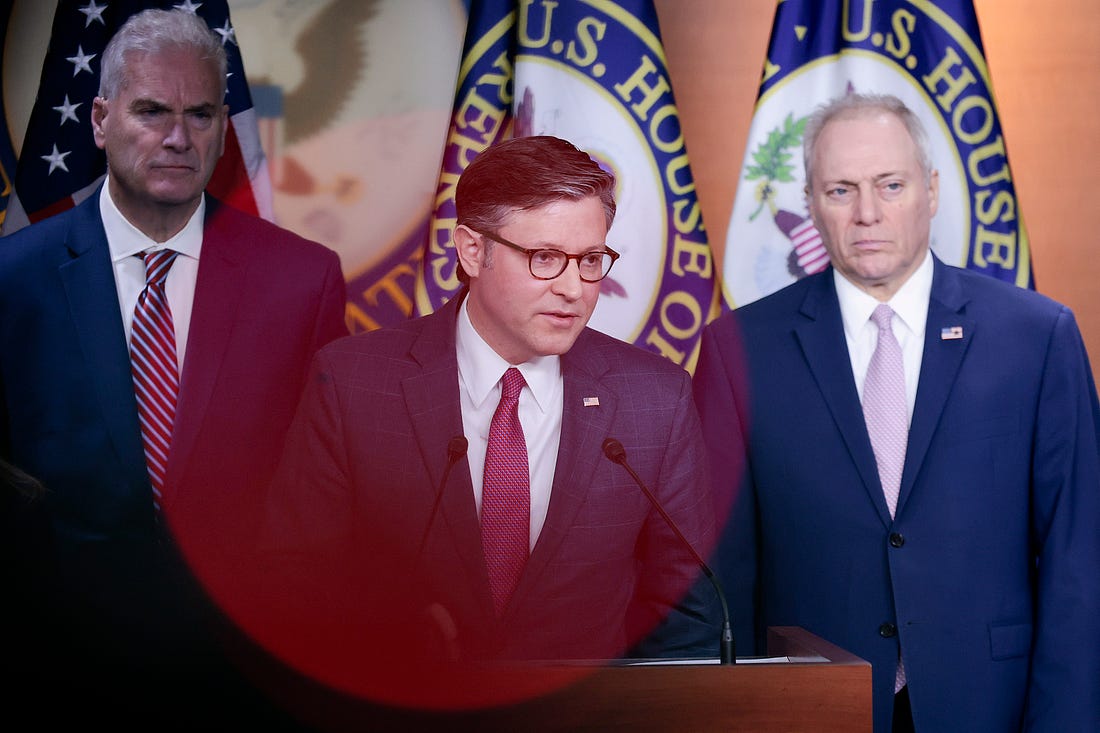
Mike Johnson, Speaker Irrelevant
The atrophied chamber is moving legislation without GOP leadership’s blessing.
|

| |||||||||||||||


 |
Diss track
Call it a holiday miracle if you must. But the last days of 2025 have seen multiple instances of bipartisan cooperation in the House.
And it’s not just cases of well-adjusted moderates and party brass making difficult compromises to avoid a catastrophe. Instead, what we’ve seen is aggressive procedural rules-gaming by a variety of members to circumvent House leadership through the use of discharge petitions.
The increasing frequency of these end-runs around leadership is a forceful demonstration of just how sick and tired rank-and-file Democrats and Republicans are of trying to work in a chamber run by an obsequious speaker who sees his role as doing the bidding of a power-hungry White House.
To understand how big a middle finger the discharge petitions are to Mike Johnson, you first must understand that they were vanishingly rare before the current Congress. The maneuver, which allows a bill to move out of committee and on to the floor with the signature of 218 House members, has been successful just twice since the beginning of the 21st century. Since 1935, less than four percent of discharge petitions garnered enough signatures to even receive a vote. In the modern era, discharge petitions have typically come from swing-district members of the majority banding with the minority. But already this year, one has been successful and we could see a few more passed in the weeks, months, or year ahead.
“They’re always supposed to be an option of last resort,” Rep. Brian Fitzpatrick (R-Pa.) told me. “Typically they’re a tool of the minority, but you’re seeing it happen in the majority a lot more.”
Fitzpatrick has an active discharge petition of his own to advance a wide-ranging bill filled with tax provisions, and he said more are on the way.
“I’ve filed several,” he said. “I have a shell that I’m gonna use for Russia sanctions, I did this one with [Rep. Jared Golden (D-Maine)] on collective bargaining, I’ve discharged the Let America Vote Act, which is independents voting in primaries, I’ve discharged [a bill] preserving the filibuster—I’ve done a lot.”
“But I really wish these bills would just come to the floor on their own,” Fitzpatrick added. “It shouldn’t take a discharge petition. Leadership should be putting these bills on the floor when there’s that much support for it. A discharge is really forcing rank-and-file members to take matters into their own hands.”
Before this year, discharge petitions succeeded so rarely that they weren’t even taken to be a viable option. They typically gain a few signatures from lawmakers in the minority party and then sit in limbo until their eventual expiration. But since late summer, several discharge petitions have gained broader support from lawmakers and generated large amounts of public interest in the process.
So far, at least two have garnered the necessary 218 signatures to force a vote: a bill to restore the collective bargaining rights for federal workers, and the fall’s biggest driver of the legislative news cycle: Reps. Ro Khanna (D-Calif.) and Thomas Massie’s (R-Ky.) Epstein files bill. Both petitions passed on the strength of combined Republican and Democratic support, but the aisle-crossers for each came from markedly different coalitions. The Epstein bill got over the finish line thanks to far-right members—especially dissident Republican women—holding their ground against Trump, while the collective-bargaining bill passed thanks to GOP moderates allying with Democrats.
Now the House hopper is filling up with additional discharge petitions. One would force a vote on banning stock trading for members of Congress. Led by Rep. Anna Paulina Luna (R-Fla.), it currently has 67 signatures. Some Democrats haven’t signed on because they remain opposed to it, while others are holding off because they want additional restrictions for officials in the executive branch. Coincidentally, just a few days after I asked Rep. Cleo Fields (D-La.) about his