|
Dear all,
Please find below your weekly update from the UK Health Security Agency (UKHSA).
If you have any questions please get in touch by emailing externalaffairs@ukhsa.gov.uk
As always, you can also follow UKHSA on X, on Instagram, on BlueSky, and on LinkedIn for all the latest updates. You can also find the latest news from UKHSA on our news page on GOV.UK.
Best wishes,
UKHSA External Affairs Team
New stories
- UKHSA issues red heat-health alerts across England
- UKHSA update on the hantavirus cruise ship outbreak
- UKHSA Conference 2026 – sponsorship and exhibition sales closing soon
Ongoing issues
- MenB one-off vaccination programme
- Latest measles figures published as two deaths confirmed in 2026
- UK Public Health Rapid Support Team deploys in response to the Ebola outbreak
UKHSA communications toolkits
- Information on how to access UKHSA communications toolkits
UKHSA data, analytics and surveillance
- Statistics at UKHSA
- UKSA data dashboard
- Notification of Infectious Diseases report
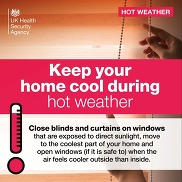
UKHSA issued a red heat-health alert (HHA) for 6 regions of England on Monday. The West Midlands, East Midlands, South East, South West, London, and East of England are under a red heat-health alert until 11pm on Thursday 25 June. In addition, an amber alert has been issued for the North West, North East, and Yorkshire and the Humber for the same period.
A red heat-health alert indicates that a severe heatwave could have impacts beyond health and social care with potential effects on transport systems, food, water, energy supplies and businesses, and indicates a risk to life for even the healthy population.
Individuals and organisations that wish to receive the impact based HHA must register to receive the alerts where users will be able to specify which regions they wish to receive alerts for. The alert status is also publicly available on the UKHSA Data Dashboard.
To support stakeholders with their communications during periods of hot weather, we have a communications toolkit available. The material in this toolkit is intended to provide basic health information that can be communicated during hot spells so that the right messages reach the right people at the right time. This year we have included some new messaging on staying safe from direct sun.
There are also a series of blog posts which your audiences may find useful:
If you are unable to access the toolkit, please email externalaffairs@ukhsa.gov.uk and we can send across a hard copy. Please do not publish the toolkit anywhere online to prevent old, outdated versions of the toolkit circulating.
|
On Monday, UKHSA confirmed that all remaining individuals have now left Arrowe Park.
All passengers from the MV Hondius who subsequently returned to the UK have now completed their self-isolation periods.
Professor Robin May, Chief Scientific Officer at UKHSA, said:
"We would like to reiterate our thanks and gratitude to passengers, crew and other contacts for their cooperation throughout what has been a very challenging time for everyone affected.
"Our teams will continue to work closely with local authorities and the NHS to ensure everyone affected by this outbreak has the necessary support in place."
You can find further updates on the public health response:
|

The UKHSA Conference 2026 will take place on Tuesday 22 and Wednesday 23 September at Manchester Central. The conference will bring together partners from across public health, health protection and the wider health security community to share learning, showcase innovation and strengthen collaboration.
Exhibition stands are available to purchase, offering a fantastic opportunity to showcase your organisation to delegates from across the health security community. Sponsorship packages are also available for organisations looking to raise their profile and support this flagship event. To find out more about exhibition and sponsorship opportunities, check out our Sponsorship and Exhibition Brochure. To book your space or find out more, please contact conference@ukhsa.gov.uk or complete the booking form UKHSA Conference 2026 Sponsorship and Exhibition application before Friday 3 July.
|
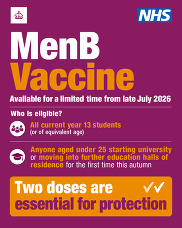
Earleir in the month Department of Health and Social Care (DHSC) and devolved nations announced that thousands of young people will get protection against meningococcal B disease (MenB) through a one-off vaccination programme launching ahead of the 2026 academic year.
The one-off vaccination programme will be offered to:
- Everyone in England and Wales born between 01/09/2007 and 31/08/2008 (current school year 13) or equivalent final year of school age (Year 14 or S6) in Scotland and Northern Ireland.
- Everyone turning 25 after 31/12/2026 who will be starting higher education for the first time, or who will be living in further education accommodation or halls of residence for the first time, in autumn 2026. This includes international students and students in the UK Devolved Administrations and Crown Dependencies.
- International students under 25 entering their first year of university should receive their first dose in their home country where possible.
Eligible people will need two doses for protection, with the first being offered from July and the second dose provided from August.
We have also published our Q&A style blog post to help answer some questions people might have about this vaccination offer.
We are in the process of creating a communications toolkit to support stakeholders promote the offer to those eligible. We will share this resource in this bulletin ahead of the national booking system going live on 13th July.
|
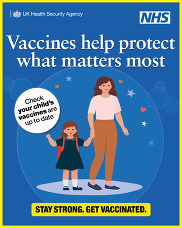
Our latest measles data shows that measles continues to circulate in many parts of the country.
This data includes the confirmation that, sadly, to date in 2026, there have been 2 measles deaths in children in England. Our thoughts and condolences are with the families who have so tragically lost their children.
Measles activity increased earlier this year, mainly due to outbreaks in London and the West Midlands, with the majority of cases in unvaccinated children aged 10 years and under.
Since the last update, a further 106 laboratory confirmed measles cases have been reported in England, bringing the total number of confirmed cases between 1 January and 8 June 2026 to 736, compared to 959 cases for the whole of 2025. In the most recent 4 weeks, activity has been highest in London, the East of England and the West Midlands.
We continue to work with partners to urge parents to check their children are up top date with their MMR or MMRV vaccines to give them the best and safest protection against measles.
Further resources
- We have a measles communications toolkit which brings together a range of resources which partners can use to raise awareness of measles, its signs and symptoms, and the MMR/MMRV vaccination offer. This is available on our Google Drive.
- There are also wider communications assets available which have been designed as part of UKHSA, DHSC and NHSE’s campaign to encourage uptake of routine childhood vaccinations for children aged 0–5. These are available on the Campaign Resource Centre.
|
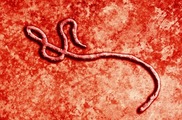
UKHSA is deploying the first seven public health specialists from the UK Public Health Rapid Support Team (UK-PHRST) to the Ebola outbreak in the Democratic Republic of Congo (DRC) and across the region:
- Four will be based in Eastern DRC, supporting WHO field operations across infection prevention and control, epidemiology, and risk communication and community engagement (RCCE).
- A further RCCE specialist is being deployed to the WHO Country Office in Kinshasa.
- An epidemiologist is being deployed to the Republic of Congo to support the wider regional response.
- Additional support is being provided remotely by a data modelling expert.
UK-PHRST brings extensive experience to the current response, including 10 deployments to Eastern DRC during the 2018/19 North Kivu Ebola outbreak - part of more than 50 deployments involving over 100 people in the last nine years.
As the situation in the DRC and wider region develops, we are continuously updating our blog post 'what is Ebola and how does it spread?'.
We have also updated our Returning Workers Scheme (RWS) advice for people returning to the UK after working in an Ebola or Marburg virus affected area.
|
The UKHSA External Affairs Team prepares a range of communications toolkits to support stakeholders to communicate health security messaging to your networks.
Our live toolkits cover a range of issues including outbreak response, vaccination programmes, and resources to help mitigate against the health impacts of adverse weather.
These can all be found on our Google Drive. Our vaccine communications toolkits are also available on the Campaign Resource Centre. If you are experiencing any issues accessing the Drive or the CRC, or have any questions on the toolkits please email externalaffairs@ukhsa.gov.uk.
UKHSA collects and publishes statistics, data and analysis related to planning, preventing and responding to external health threats. This includes official statistical publications on COVID-19, immunisation, healthcare associated infections, other infectious diseases, mortality surveillance and sexual and reproductive health. These can be found on our statistics page on GOV.UK.
The UKHSA data dashboard provides a weekly summary of public health data. It has recently been updated to include Invasive Group A Strep, tick surveillance and hepatitis C data. Over time, the data dashboard will be expanded further to present a wider range of data on public health topics in line with the remit of the UKHSA.
The weekly UKHSA NOIDs publication is currently paused (from 3 April 2025) to make changes, including adding the notifiable diseases which became reportable under the Health Protection (Notification) (Amendment) Regulations from 6 April 2025.
Public health action will continue to be taken on notifications as usual. It will not be impacted by the reporting development work.
For reports already published, please be aware that due to changes in how the data is processed and mapped, including local authority codes that have been updated to the latest geographies, it would be inaccurate to compare data since week 27 to historic reports.
The causative agent reports will continue to be published.
You can unsubscribe from this newsletter at any time by managing your subscriber preferences at the link below. if you are experiencing any issues please email externalaffairs@ukhsa.gov.uk and we can delete you from our subscriber list manually.
|