|
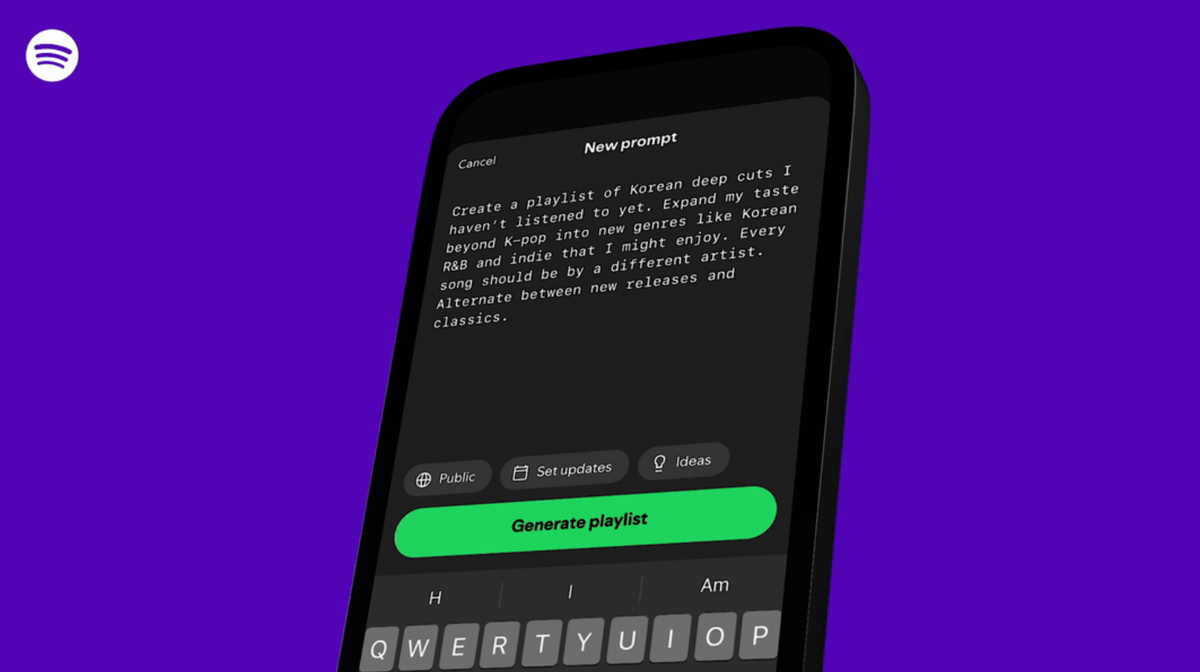
Today I propose taking a respite from our various branching crises to talk about how Spotify built one of its best features in years: prompted playlists, which use AI to effectively leverage years of individual listening data and chatbots’ world knowledge to create the kind of self-updating playlists I have wanted now for years. (And if that sounds a bit too lightweight, scroll down for some news about Meta’s AI plans.) Just before the holiday break, Spotify co-CEO Gustav Söderström announced the beta test of prompted playlists. The pitch was straightforward: instead of creating a playlist manually or via individual song suggestions, just type a message out to Spotify and let a large language model assemble one on your behalf. “You could ask for ‘music from my top artists from the last five years,’ then push it further with ‘and feature deep cuts I haven’t heard yet,’” Söderström wrote. “Or you could request ‘high-energy pop and hip-hop for a 30-minute 5K run that keeps a steady pace before easing into relaxing songs for a cool-down,’ and layer on something like ‘include music from this year’s biggest films and most-talked-about TV shows that match my taste.’ You choose how broad or specific you want to go.” As it so happened, none of these particular prompts appealed to me. I wanted something much more specific: to recreate the Smart Playlists that have existed in iTunes since 2002. As a huge music fan, I have long tried to balance listening to new songs with a system to ensure that I regularly revisit old favorites. Smart Playlists made this trivial: I rated the songs in my collection from one to five stars, then used a Smart Playlist to show me four- and five-star songs I hadn’t listened to within the past few months. The streaming era brought many gifts with it, but Smart Playlists were not one of them. Spotify made some efforts toward highlighting listeners’ most-streamed tracks and rediscovering older songs, such as with its annual Wrapped feature and Throwback Thursday playlists. But if all you wanted was a playlist that showed you an updated list of great songs you hadn’t heard in a while, you were out of luck. Then, on January 22, prompted playlists entered beta testing in the United States and Canada. When I created my first one last week, I wasn’t certain it would work. None of the prompts Spotify had talked about in their promotional materials had mentioned time-based listening data with the level of granularity I was hoping for. Still, I gave it a shot. “Create a playlist of songs that I have listened to at least 20 times but haven’t streamed in the past two months.” Spotify went to work, and within a minute or two I had the playlist I was looking for. As I looked over the tracks, it seemed that Spotify really had used the decade-plus of listening data it has on me to find songs I hadn’t heard in months. The playlist did have its flaws. There was a year where I fell asleep almost every night listening to Sufjan Stevens’ Carrie & Lowell; the first prompted playlist I created included about half of that album. If the playlist was going to be limited to a few dozen tracks, I wanted more variety. And so, at my boyfriend’s suggestion, I refined the prompt further: “Songs I’ve listened to twenty times but not in the past two months. Please don’t repeat albums. Create a well sequenced playlist drawing from this set, rather than just ranking by play count. Don’t mention play counts in your descriptions.” This gave me the playlist I actually wanted: one I could just hit “play” on every day without thinking too much about it. The reason is that you can set prompted playlists to update themselves either daily or weekly. (If you choose the latter, you can even pick the day.) This means I now spend less time searching for things and more time listening to music. I wanted to know more about how prompted playlists worked. And so on Tuesday I met virtually with Molly Holder, Spotify’s head of personalization. “Something we hear from users all the time is that they want more control,” Holder told me. Last year, the company gave its AI DJ the ability to take requests. The next step was to make playlists more interactive.
Upgrade to continue reading.
Become a paid member of Platformer to get access to all premium content.
|