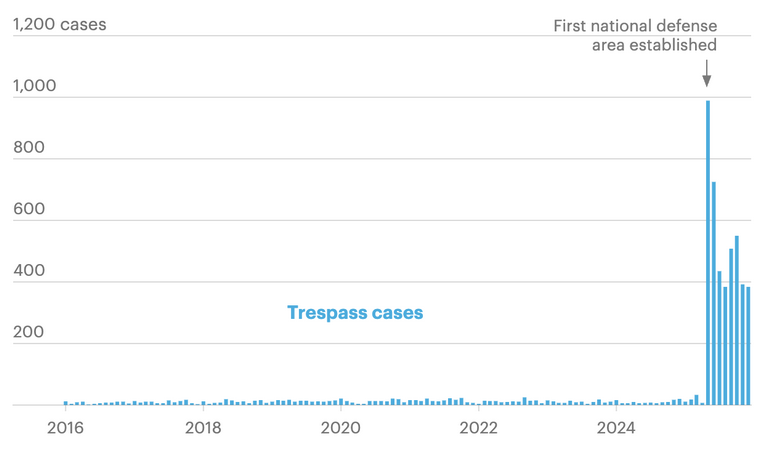
Note: Counts are of unique cases in which charges were filed under 50:797 (“Penalty for violation of security regulations and orders”) and 18:1382 (“Entering military, naval, or Coast Guard property”). Source: Federal Justice Center’s Integrated Database
Nearly all of these charges originated from cases along the U.S. southern border, where last spring, the White House designated large swaths of land as national defense areas. Putting them under military authority allowed troops to play an unprecedented role in apprehending undocumented immigrants; federal soldiers are generally barred from enforcing the law on domestic soil. If you were caught in one of these zones, the government could also now prosecute you for breaking federal laws, including one enacted in 1909 to keep spies away from arsenals.
In an investigation we published this week, my co-reporters Perla Trevizo, Abe Streep, Pratheek Rebala and I dug into what experts say is a major flaw afflicting these prosecutions that threatens to ensnare people for crimes they did not commit: Migrants didn’t know the land they were crossing now belonged to the armed forces. And many judges have ruled that you can’t be guilty of trespassing on military land if you had no idea you were on it.
Since April of last year, we found, at least 4,700 immigrants already charged with entering the country illegally faced these military trespass charges; at least one had to wait in jail for more than a month to stand trial. Most of the charges didn’t stick. In fact, we found that in 60% of the resolved cases, the trespass charges were dropped or dismissed. Yet prosecutors kept filing them.
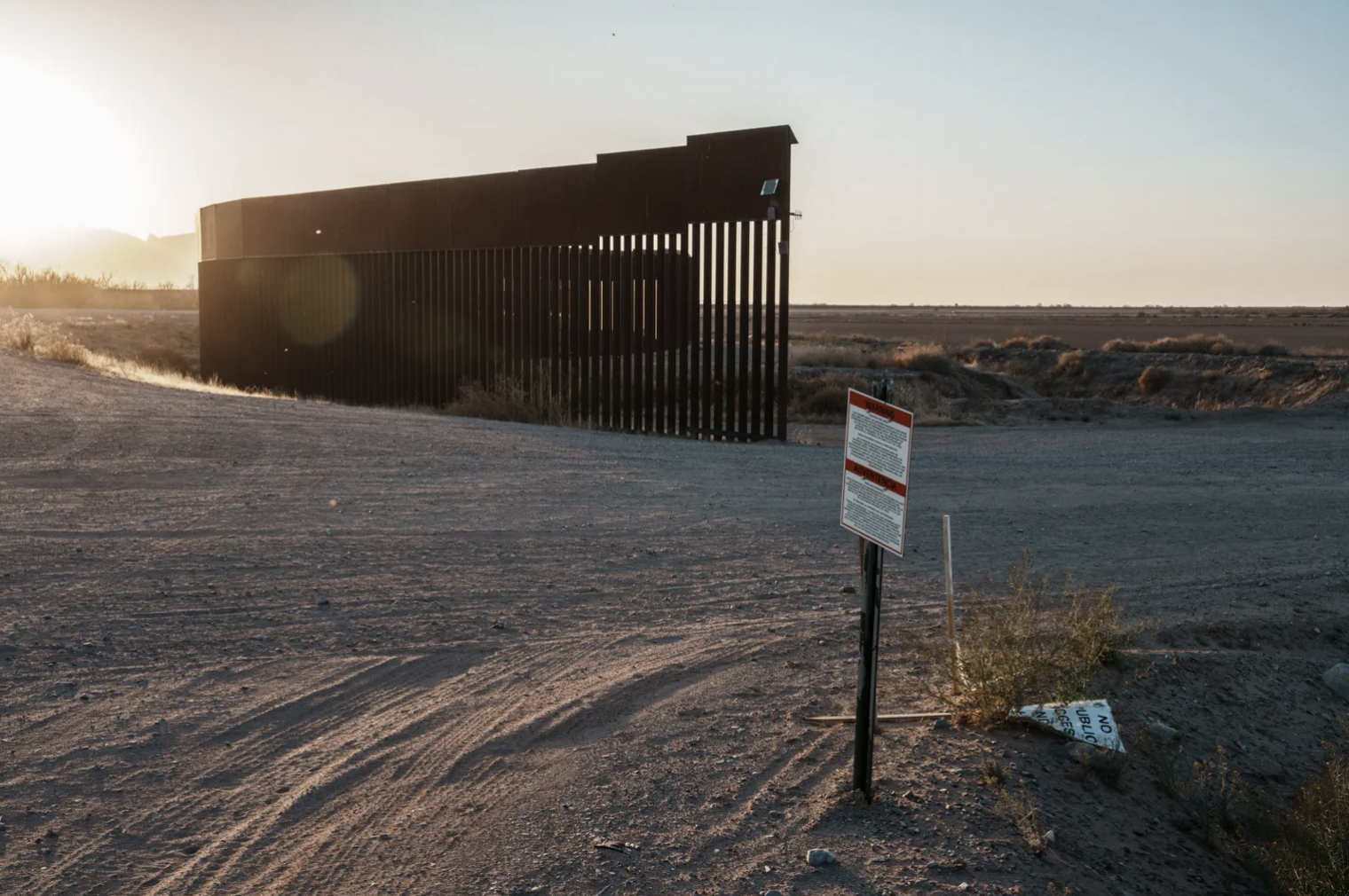
As we visited courtrooms in West Texas and New Mexico and pored through case records, it became clear how hard it would be to prove that someone knowingly trespassed on military land. Some couldn’t read. At least one person didn’t speak English or Spanish. The small signs are spaced far apart and easy to miss, and many migrants were arrested far away from them.
A Justice Department spokesperson said the prosecutions have deterred unauthorized border crossings and cartel activity. And prosecutors have argued in court that illegally crossing is enough to prove criminal intent for the military trespassing charges. Senior officials in the U.S. attorney’s offices handling trespass cases declined repeated interview requests.
In November, Perla, Abe and I set out to report throughout southern New Mexico and West Texas to see for ourselves what information we could gather about where the zones were and how they were marked.
Abe and I arranged a ride-along with Doña Ana County Sheriff Kim Stewart, whose New Mexico agency shares jurisdiction with Border Patrol and the military in one of the zones. A sergeant from her office drove us along a dirt road that parallels the border as she pointed out 12-by-18-inch red and white signs opposite the fence. She told us her office hadn’t received specific information about where the military zone boundaries were; all they had were the signs. Even in broad daylight, it was difficult to read the words on them unless we got within a few feet.