|
|
|
|
Good morning. Two years ago, a group of executives wrote to then-finance minister Chrystia Freeland, calling for the government to “amend the rules governing pension funds to encourage them to invest in Canada.” The initiative stirred considerable pushback. Today we return to that argument. Sovereign pension funds are in focus today, along with cryptocurrency convictions. |
|
|
|
|
|
|
|
|
|
|
|
|
|
|
|
|
|
|
|
|
|
|
Tariffs: Ottawa is offering $1.5-billion in tariff relief for manufacturers after U.S. levies on metal imports deepened the pain for many businesses. |
|
|
|
|
Public relations: Navigator, a national communications company known for its crisis-management skills, is dealing with an internal crisis as members of Alberta team form a competing firm. |
|
|
|
|
|
|
|
|
|
|
|
|
|
|
|
For too long, Canada has taken future wealth and redistributed it to the present. Photo illustration by The Globe and Mail/iStockPhoto / Getty Images
|
|
|
|
|
|
|
|
|
|
|
Whose piggy bank are pension funds anyway? |
|
|
|
|
Hi, I’m John Rapley.
After decades working in academia and the policy sector, a few years ago I took up the writing life. Among my other work, I now contribute a weekly economics column for The Globe and Mail. Recently, my editor Ethan Lou invited me to contribute to the Prosperity’s Path
series, which he had initiated with a very compelling essay. In it, he argued that the government was spending money today from the earnings of future workers – by funding its spending with debt rather than taxes. |
|
|
|
|
Today, I want to take up this baton and bring Canada’s pension system into the debate. I start with a provocative claim: one of Canada’s great strengths is also its weakness – namely that as one of the planet’s most affluent countries, Canada has in fact grown too rich. |
|
|
|
|
|
|
|
|
How can this be? Whereas we normally assume that wealth amounts to the accumulation of past income, I argue that a considerable share of Canada’s current wealth actually results from the appropriation of future income. |
|
|
|
|
This has been done through government and central bank policies that have inflated asset values, causing wealth to rise much faster than income. Drawing upon research I’ve done for my new book, I show that when that happens, the growth rate of an economy slows, and eventually can even go backward. |
|
|
|
|
In effect, today’s asset owners, not least the country’s pension plans, are supporting themselves by spending some of future generations’ earnings today, depriving our descendants of what should properly be theirs. The solution is for the government to take actions which will redistribute that income to the future – by building for the future, but also breaking some present-day eggs, with pro-growth policies. |
|
|
|
|
The good thing is that we seem to be going in this direction. |
|
|
|
|
Last week Prime Minister Mark Carney announced a sovereign wealth fund to invest in nation-building projects and generate returns, “creating even greater opportunities for future generations.” |
|
|
|
|
But Carney did not go far enough. There is a next step that governments must take, and that is to expand the mandate of Canada’s pension funds so that they invest more domestically. These funds should effectively become sovereign wealth funds as well. |
|
|
|
|
That begins with our pension funds. Two years ago I did not quite agree with the executives who pushed for a national-development mandate for those funds. But today, with a hostile United States, the situation is different. Pension funds should invest more in Canada, even if pensioners take a hit. |
|
|
|
|
Because such measures would depress asset values over the short term, it would hit the incomes of those who most benefit from that wealth – in particular, today’s pensioners. Far from being unfair, I suggest this would actually remedy an existing injustice. |
|
|
|
|
In March, the release of the World Happiness Report was damning for Canada: We fell to 25th place, down from from sixth place 10 years ago. What is interesting is where the decline came from. The report found that happiness held steady among the retired (and even rose, among some sub-groups) but fell sharply among young people. |
|
|
|
|
I’m wary of putting too much stock in happiness economics, given its methodological shortcomings, but the finding was pretty stark. And it reflects something about our society: that for too long, policies have benefitted the old at the expense of the young. |
|
|
|
|
Having pension funds invest more domestically creates a fairer society for all, all while putting Canada back on a sustainable economic path. |
|
|
|
|
|
|
|
|
|
|
|
|
|
|
|
|
Carney’s greatest challenge |
|
|
|
|
|
|
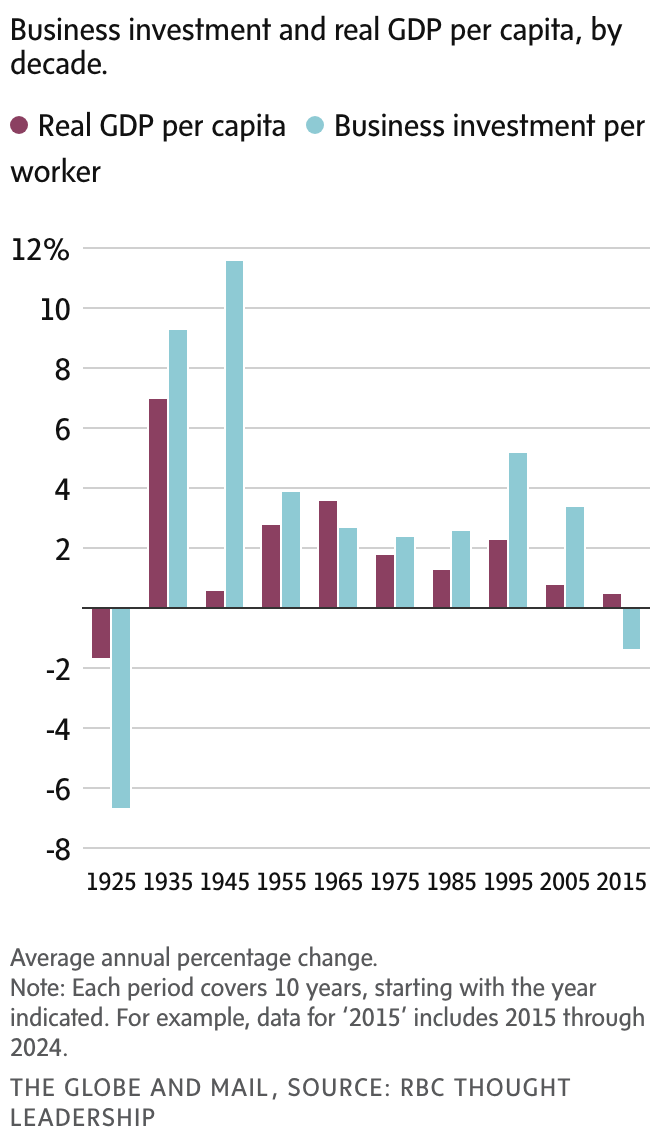
From the start of 2015 to the end of 2024, the level of business investment per Canadian worker declined – the first time since that has happened since the Depression. Canada’s catastrophic investment deficit is Prime Minister Mark Carney’s biggest economic challenge, Tony Keller writes. |
|
|
|
|
|
|
|
|
|
|
|