| | In today’s edition: A fragile ceasefire is on the brink, Gulf airlines’ fitful recovery, and OPEC+’s͏ ͏ ͏ ͏ ͏ ͏ |
| |  | Gulf |  |
| |
|
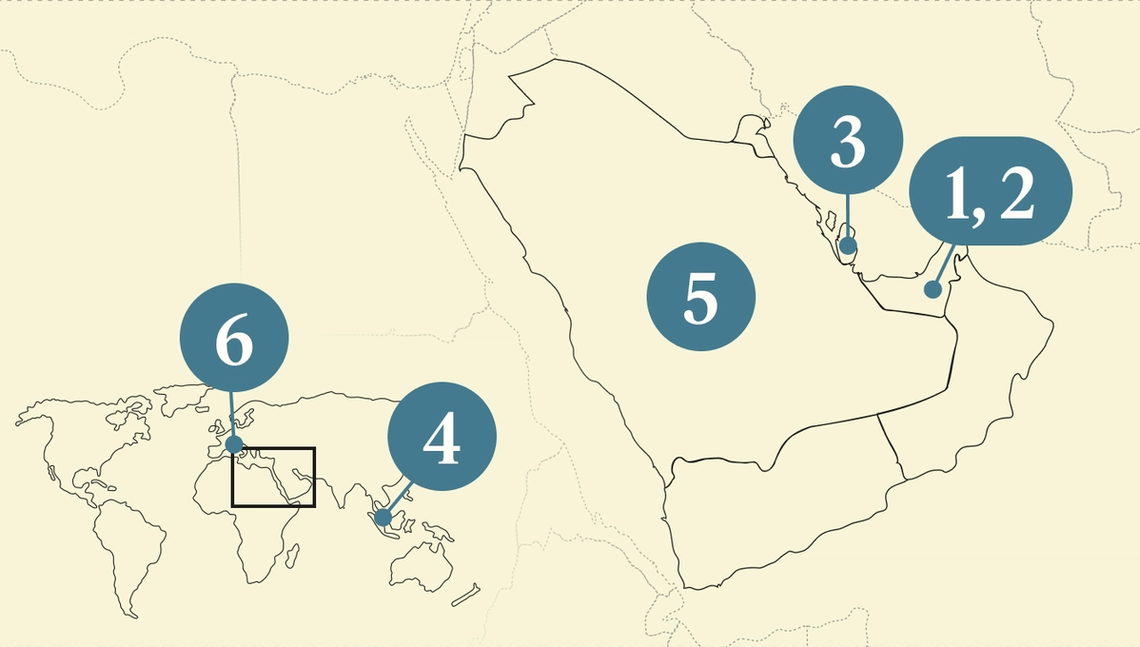 - Iran resumes UAE attacks
- Gulf airline recovery
- Qatar backs green jet fuel
- Mubadala’s logistics play
- Saudi touts AI for businesses
- Phantom barrels from OPEC+
 Saudi oil’s May Day anniversary. |
|
Ceasefire teeters after Iran strikes UAE |
| |  | Mohammed Sergie |
| |
 Amirhosein Khorgooi/ISNA/West Asia News Agency via Reuters Amirhosein Khorgooi/ISNA/West Asia News Agency via ReutersYesterday, there was a buzz across the UAE, with schools open and a major manufacturing exhibition underway. Then Iran launched a barrage of missiles and drones, striking an oil facility in Fujairah and raising concerns that the US-Iran ceasefire could collapse. By Tuesday, thin commuter traffic suggested many people had stayed home, while schools pivoted back to remote learning, and the congestion that had built up in recent weeks evaporated. The fighting began in the contested Strait of Hormuz, where the US military said it repelled Iranian attacks while protecting two American-flagged ships. The UAE also said an empty ADNOC tanker was targeted by Iran. US President Donald Trump is growing impatient with stalled negotiations with Tehran, according to Axios, while some Republican senators are drafting an authorization for the use of military force in case he decides to resume strikes, Semafor reported. At the United Nations Security Council, the US and Gulf countries (excluding Oman) are reportedly planning to submit a resolution to compel Iran to reopen the strait; an earlier attempt was blocked by China and Russia. At chef Mohamad Orfali’s Three Bros restaurant in Dubai, diners didn’t flinch as their phones screeched with the first missile alerts in weeks, instead tucking into their gambas, burnt leeks pide, and tomato water kombucha. But the renewed fighting quickly shifted industry sentiment: One hospitality group reversed a decision made just days earlier to restore salaries cut in March, according to messages seen by Semafor. |
|
Gulf aviation’s cautious recovery |
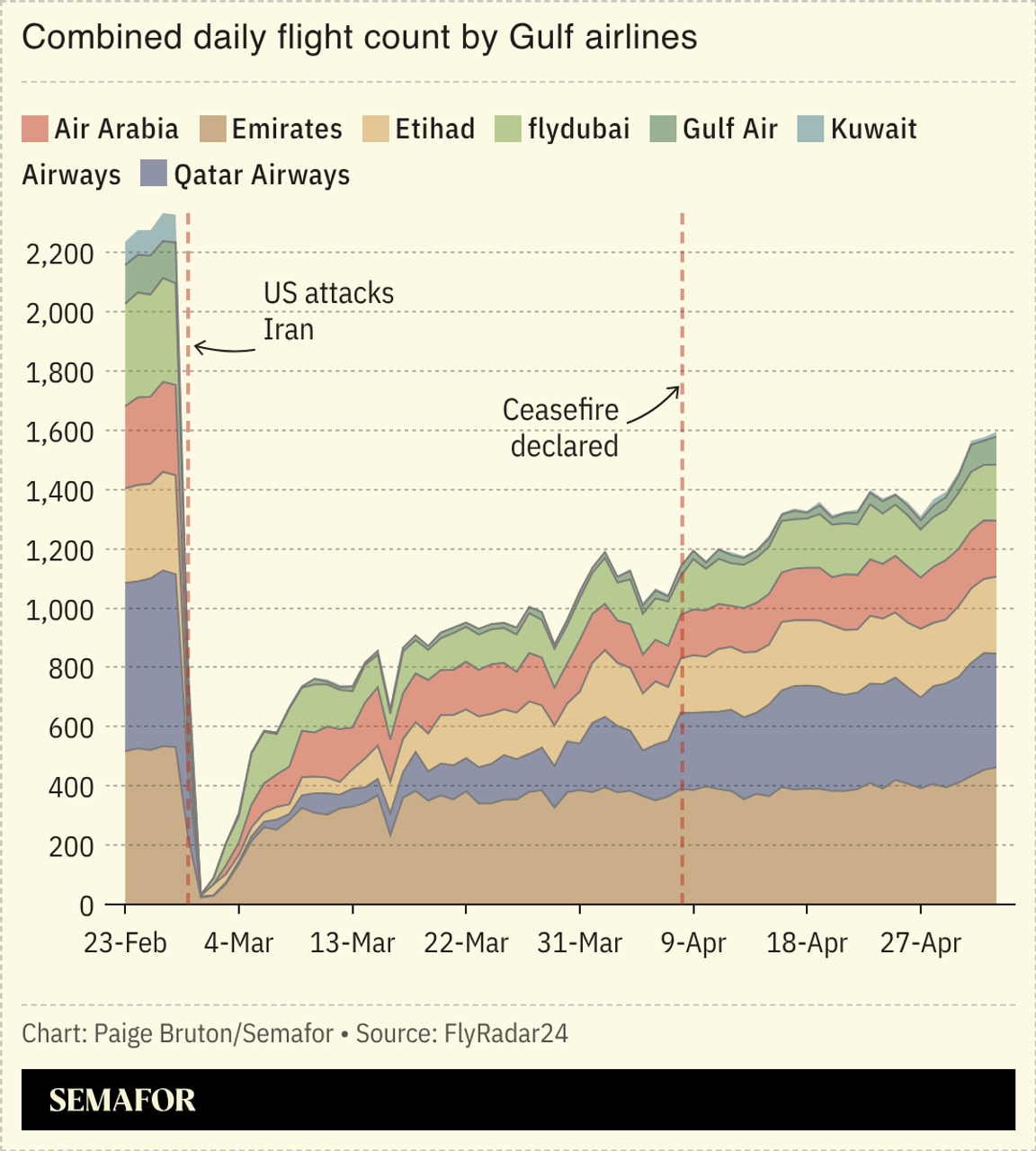 Renewed Iranian strikes on the UAE on Monday forced incoming flights to stay in holding patterns or reroute, before operations returned largely to normal overnight. The episode was a reminder of the aviation sector’s fragile position: Dubai International Airport had only just returned to what CEO Paul Griffiths described as full capacity, after operating at 38% of its normal rate for most of April. In an interview with The National, he said first-quarter passenger numbers were down 21% year-on-year, but he predicted “very strong passenger growth numbers over the next few months.” Doha’s Hamad International is recovering more slowly. Qatar Airways is targeting 150-plus destinations by mid-June, from a prewar peak of roughly 170. Riyadh is also in a phased recovery, with Saudia now running roughly half its capacity before the crisis and British Airways due to restart services on May 20. Other European carriers, including KLM and Lufthansa, have suspended service across most Gulf routes through late June and beyond. The risk of further wartime disruption remains high, and elevated fuel costs add another challenge, but local carriers could at least face a market with fewer international competitors for a while. — Kelsey Warner |
|
Qatar backs sustainable jet fuel |
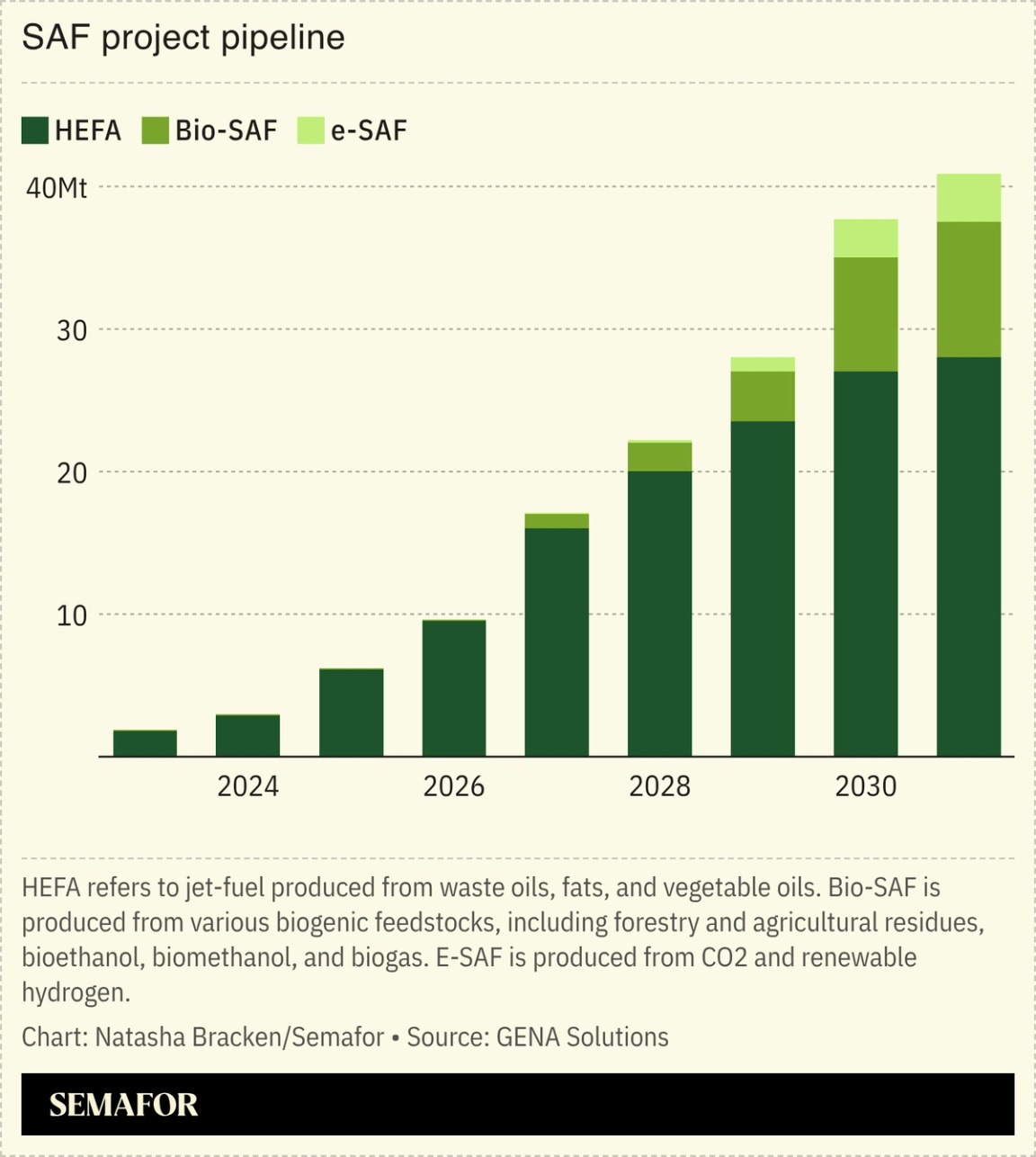 The risk of a shortage of aviation fuel due to the Strait of Hormuz blockade has made the search for alternative sources a critical issue for airlines. High fuel prices and pending scarcity means some carriers have canceled flights and at least one, Spirit Airlines in the US, has closed down. One possible long-term answer is sustainable aviation fuel, which, because it is typically made from waste oils, biomass, or other renewable sources, is not as dependent on Middle East energy flows. Qatar’s largest bank, QNB Group, is the latest to step into the sector, by lending to an SAF plant being developed in Egypt. Last week its local subsidiary, QNB Egypt, agreed to help finance the project. The plant should be up and running next year, and will be able to produce some 200,000 tonnes of biofuel a year — equal to around 10% of current global SAF supply. Energy giant Shell has signed up to buy the entire output of the plant, which is being developed by Doha-based Green Sky Capital. — Dominic Dudley |
|
Mubadala backs shipping container deal |
 The size of Mubadala’s co-investment with infrastructure investment firm Stonepeak to support Textainer’s acquisition of Singapore-based Seaco, which will create one of the world’s largest container leasing platforms. The deal builds on Stonepeak’s 2024 takeover of Bermuda-based Textainer and expands its scale in key global trade routes, particularly in Asia. The combined company will manage more than 8 million shipping containers. For Mubadala — which has been one of the world’s most active sovereign funds in recent years — the investment adds to its logistics infrastructure portfolio that includes one of North America’s largest trailer leasing companies.
|
|
Saudi targets AI for businesses |
 Leonie Asendorpf/picture alliance via Getty Images Leonie Asendorpf/picture alliance via Getty ImagesSaudi Arabia’s artificial intelligence champion HUMAIN is deepening a partnership with Amazon Web Services, as the kingdom looks to position itself as a key player in providing AI to businesses. HUMAIN ONE, the Saudi firm’s agentic AI operating system, will be available globally through the AWS software store and run on AWS’s global data centers, including one planned in Saudi Arabia. The operating system is intended to give organizations of any size the ability to start using AI through a single platform, rather than spread across a variety of different products. HUMAIN and AWS first announced a plan to invest $5 billion in AI infrastructure and training in May 2025. |
|
View: OPEC+’s unrealistic production pledge |
  Fayez Nureldine/AFP via Getty Images Fayez Nureldine/AFP via Getty ImagesOn Sunday, seven OPEC+ countries announced they would add 188,000 barrels a day to global supply, but with the Strait of Hormuz still closed some of those producers aren’t able to ship even a single barrel, independent energy commentator Wael Mahdi wrote in a column for Semafor. The pledge to increase output was described as a commitment to market stability, but what it really demonstrates is the gap between the group’s messaging and physical reality. This matters because the promise of higher output is offering false hope about the speed of any recovery. In reality, “the road back to stable oil markets is longer and more technically treacherous than any government is willing to say,” he writes. |
|
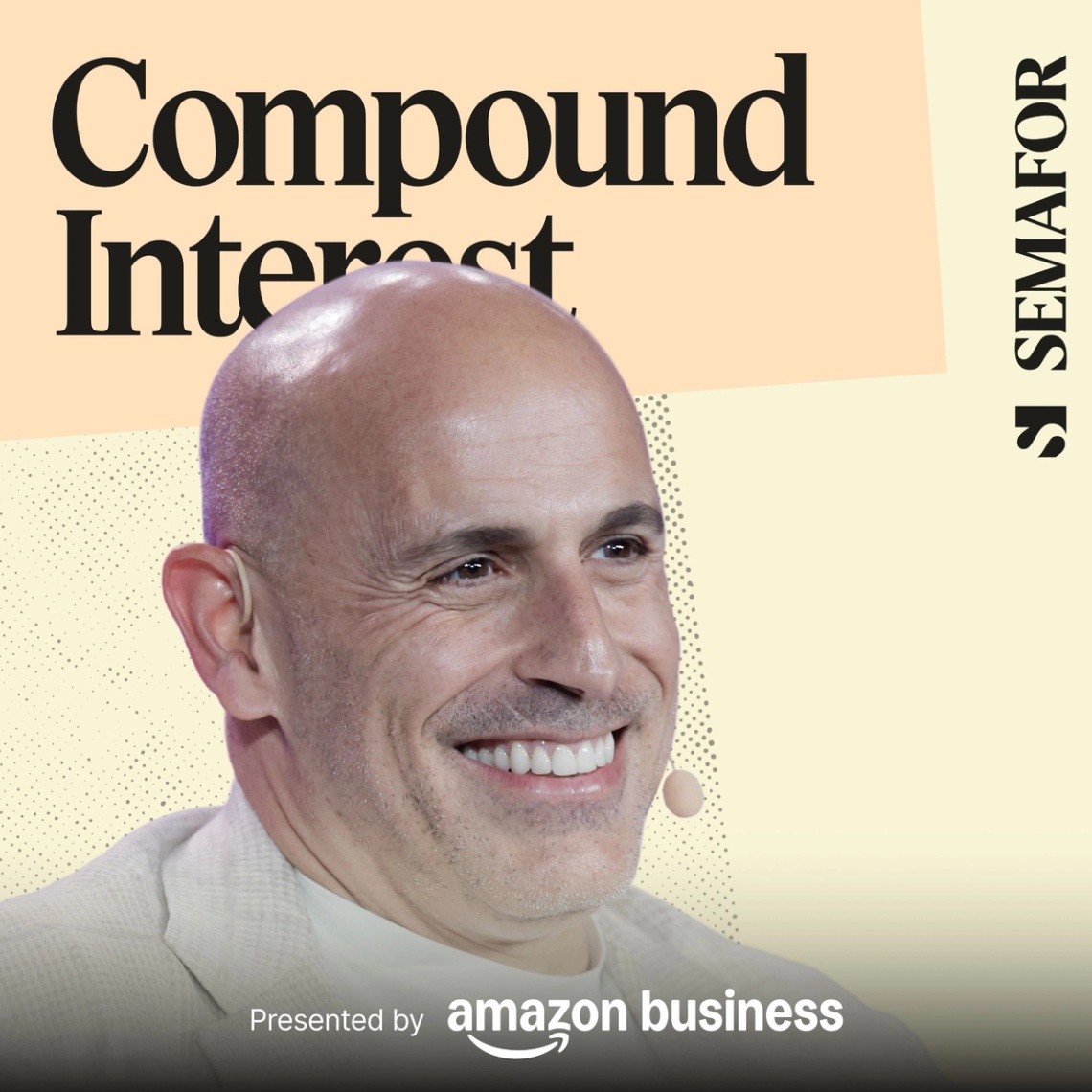 Marc Lore built Diapers.com and sold it to Amazon. Then he built Jet.com and sold it to Walmart. Now he’s trying something different: Taking Wonder — his vertically integrated food-delivery startup — all the way to a public offering. On this week’s Compound Interest, presented by Amazon Business, he joins Liz and Semafor’s Deputy Editor-in-Chief Shelly Banjo to talk about why he’s betting that robots, influencers, and AI-directed meal plans can finally crack the code on profitable food delivery and what e-commerce taught him about attacking fat margins with automation. Plus, why he’s quietly searching for desert land to build a city from scratch. Listen to the latest episode of Compound Interest now. |
|
 Bonds- Abu Dhabi and Qatar have maintained their high sovereign credit ratings, with large fiscal buffers and sovereign wealth assets helping offset risks from the Iran war so far, according to Fitch Ratings. Strong ratings will allow them to tap international debt markets at favorable rates at a time when they will need to invest in postwar economic recovery. — The National
Commodities- Wealthy investors have been shifting gold out of Dubai to Singapore amid war-related insurance concerns, with Singapore’s gold imports from the emirate hitting a five-year record of 1,446 kilograms (3,188 pounds) in March. — Bloomberg
Defense- The UAE is considering setting up a new defense sector fund which will both invest in global manufacturers — Ukrainian and Turkish drone firms are among the possible targets — and expand domestic production. Senior figures are involved in the planning, including Abu Dhabi Crown Prince Sheikh Khaled bin Mohamed and Mubadala CEO Khaldoon Al Mubarak. — Bloomberg
- The UAE’s homegrown defense conglomerate EDGE Group is working on more than $25 billion worth of orders, half of which are destined for overseas customers, its CEO Hamad Al Marar said on the sidelines of the Make it in the Emirates trade fair.
- Iran says it has been reverse engineering advanced munitions dropped by the US which never exploded, including GBU-57 “bunker busters” which Washington has used to target the country’s nuclear facilities in the past. — Amwaj Media
Stock markets- The IPO of Saudi IT services firm Dar Al Balad for Business Solutions was priced at the top of its indicated range, following strong institutional demand. The company’s listing — one of the few to go ahead since the Iran war began — gives it a value of 682 million riyals ($55 million). — Enterprise News
|
|
 saudi_aramco/X saudi_aramco/XFour score and seven years ago, Saudi Arabia’s founding father King Abdulaziz crossed the Dahna Desert in a convoy of 400 cars to reach the Gulf port of Ras Tanura, where a tanker called the DG Scofield was waiting. Aramco’s archival footage shows the monarch turning the valve himself, enabling the first shipment of Saudi oil to leave on May 1, 1939. The well it came from, Dammam No. 7, produced for 45 years and yielded more than 32 million barrels before it was finally plugged in 1982. During those years and sin |
|
|


