
|
 |


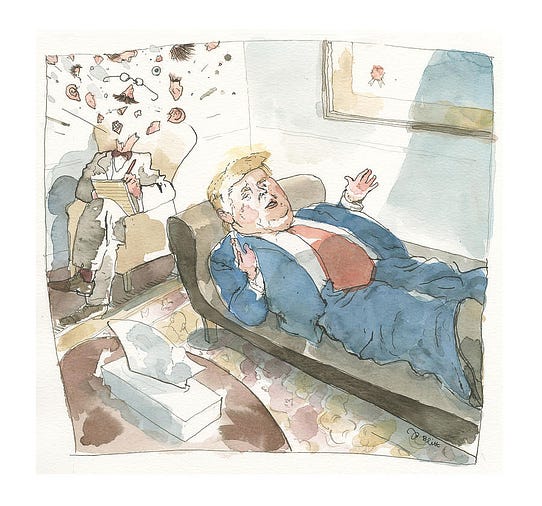
The Trump administration is finally willing to discuss mental health. But here’s the rub, it’s not their own, it’s yours. “Health Secretary Robert F. Kennedy Jr. on Monday announced several initiatives intended to rein in the prescription of selective serotonin reuptake inhibitors, the most widely prescribed class of antidepressants, which he has described as exceptionally difficult to quit.” About one in six adults in America is on an S.S.R.I. (such as Zoloft, Lexapro, Paxil or Prozac), so it’s perfectly reasonable to have a national discussion about the benefits, side effects, possible overuse, and the difficulty getting off of this class of drugs. It’s just not perfectly reasonable to have that discussion led by a brain-wormed, raccoon genital removing, bear cub collecting, conspiracy-theorizing, measles promoting, quack like RFK Jr and a maddening administration that makes the use of psychotropics feel almost mandatory (not to mention their boss, whose acting out of a running list of symptoms makes it seem like he’s trying to turn the DSM into a one-man show). NYT (Gift Article): Kennedy Starts a Push to Help Americans Quit Antidepressants. I’d posit that the quickest way to decrease the popping of mental health drugs would be a blue wave during the midterms. Let’s reuptake this matter at that time.
 |
2
It’s Always Shark Week
“Kalshi and its competitor Polymarket advertise themselves as life-changing tools for regular people—implying everyone has a fair chance to score. ‘I was about to be unable to pay my rent, but I got two years of rent through Kalshi’s predictions,’ gushed one woman in a Kalshi ad on TikTok. But for most users the reality is nothing like that. Instead, casual traders are bleeding cash while a small number of sophisticated pros—including trading firms with access to vast streams of data—eat their lunch.” WSJ (Gift Article): Why Almost Everyone Loses—Except a Few Sharks—on Prediction Markets.
+ Online casinos have developed ways to make their wares so addictive that people can’t stop playing even when there’s no promise of an eventual payout. Bloomberg (Gift Article): The $11 Billion Casino-Style Economy Built on Players Who Can Never Cash Out. “You download the game at no cost and start with a small stash of coins. But you’ll almost certainly run out—because, as at every casino, the house always wins. Then you’ll be prompted through a stream of pop-ups to pay real money for more coins, to avoid waiting (maybe an hour, maybe all day) for the game to dispense more free ones. Even when you pay, and win, you can’t cash out. It’s the defining element of a social casino; the prize is the make-believe coins, and perhaps some dopamine.”
3
Obliteration Clarification
“U.S. intelligence assessments indicate that the time Iran would need to build a nuclear weapon has not changed since last summer, when analysts estimated that a U.S.-Israeli attack had pushed back the timeline to up to a year, according to three sources familiar with the matter.” Reuters: US intelligence indicates limited new damage to Iran’s nuclear program, sources say.
+ The way war is changing could be a bigger story than this particular war. NYT (Gift Article): Operation Epic Fury, Meet Operation Colossal Blunder. “There are now only two outcomes to the conflict: either the kind of wholesale destruction of Iran that Mr. Trump posited, or a settlement that will leave the government intact and empowered, and a blustering American president humiliated. The first option is increasingly remote. By publicly threatening the commission of war crimes on an enormous scale, Mr. Trump has given both his domestic and foreign opponents time to marshal resistance. As for the latter and more likely outcome, this was predictable, if only the president and his administration had bothered to take note of a new feature of modern warfare, a feature that can be boiled down to a single word: drones.”
+ Hegseth says the ceasefire is holding, despite fighting in the Strait, and explained that the US has established a “powerful red, white and blue dome” across the Strait of Hormuz as a “gift to the rest of the world.” (Hey World, you’re welcome!) Meanwhile, Trump promises he’s been making “tremendous deals.” Here’s the latest from BBC, NBC, and The Guardian.
4
The Golden Calf
We’re living at the intersection of a protein craze and the midterm elections, so you can be sure there will be a lot of finger-pointing when it comes to America’s high beef prices (that are unlikely to come down anytime soon). But, like most economic trends, this one is more complicated than it seems. “There’s no quick fix for tight supplies, as the sticker shock in the grocery aisles didn’t happen overnight. It’s not just that the animals take a long time to grow. The complicated economics of cattle ranching also create pain points at key stages of production.” Bloomberg (Gift Article): One Calf Shows Why Record Beef Prices Still Aren’t Coming Down.
5
Extra, Extra
Equal Pay: “The practice — supported by artificial intelligence and known as dynamic pricing or surveillance pricing — can lead to two consumers paying different amounts for the same item from the same retailer, at roughly the same time. If a store knows, for example, that one of those customers lives in a wealthier neighborhood, it can charge that person a higher price.” NYT (Gift Article): Maryland Is First to Ban A.I.-Driven Price Increases in Grocery Stores.
+ Maximum Sentence: “Author Daniel Kraus won in the fiction category for his book Angel Down, a story of World War I soldiers who find a fallen angel amongst the dead in No Man’s Land – a tale Kraus relates entirely within one sentence. Among other winners in the books categories were historian Jill Lepore for We the People: A History of the U.S. Constitution and Brian Goldstone for There Is No Place for Us: Working and Homeless in America.” Here are the 2026 Pulitzer Prize winners.
+If You Build It... “With only six weeks to go before the start of the World Cup, hotels at most of the cities hosting the tournament are facing a major problem: Bookings are running far below what they had expected.” (Hmm, I wonder why people aren’t excited to come visit?)
+ Hot Error: “The contrast with the United States is stark. Under President Trump, energy policy has swung back toward oil and natural gas. In the past six weeks, the Trump administrati