
|
 |
Designing Data-Intensive Applications: The Cloud & Doing the Right Thing
How the cloud changes the way we build applications, and why engineers’ ethical choices matter more than ever. Excerpt from the book, ‘Designing Data-Intensive Applications’, 2nd edition
|

| |||||||||||||||


In 2016, Martin Kleppmann published ‘Designing Data-Intensive Applications’, which quickly became a go-to book for those of us building backend applications and distributed systems. In it, Martin combined his experience as a startup founder with observations from his time at LinkedIn, and invested years of rigorous, fulltime research in the title.
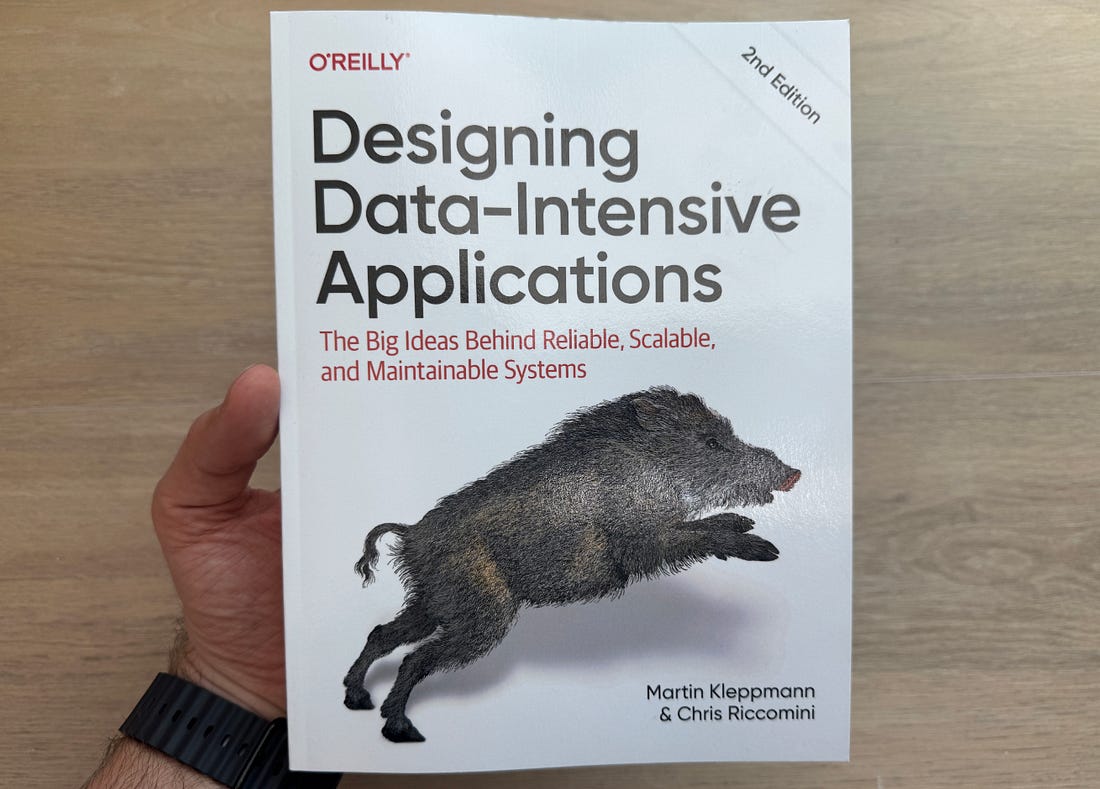
Nine years later, he felt the time was ripe for an updated edition, with cloud computing much more widespread than in 2016. So, Martin teamed up with software engineer and investor, Chris Riccomini, a former colleague at LinkedIn and the author of The Missing README, for a full refresh of the book which brings it right up to date for the present day.
 |
Martin was recently on The Pragmatic Engineer Podcast, where we discussed this updated volume and many related cloud computing matters. We also looked into some topics that have become less relevant over time, like details on MapReduce.
I asked Martin if this newsletter could share an excerpt of the updated edition of the book about a timeless, important topic, and he generously agreed. So, today we cover:
Cloud versus self-hosting tradeoffs
Doing the right thing as a software engineer
These excerpts are only part of the book; the first edition has been on my shelf for years and is now in well-worn condition. I jumped at the chance to get the second edition, and if you’re interested in building resilient systems, I recommend it as an excellent resource.
My usual disclaimer: as with all my recommendations, I was not paid for this article, and none of the links are affiliates. See my ethics statement for more.
The bottom of this article could be cut off in some email clients. Read the full article uninterrupted, online.
The excerpt below is from “Designing Data-Intensive Applications” second edition, by Martin Kleppmann and Chris Riccomini. Copyright © 2026 Martin Kleppmann, Chris Riccomini. Published by O’Reilly Media, Inc. Used with permission.
1. Cloud versus self-hosting tradeoffs
This excerpt is from Chapter 1: “Trade-Offs in Data Systems Architecture”
For anything that an organization needs to do, one of the first questions is whether it should be done in-house or outsourced. That is, should you build or should you buy?
Ultimately, this is a question about business priorities. A common rule of thumb is that things that are a core competency or a competitive advantage of your organization should be done in-house, whereas things that are non-core, routine, or commonplace should be left to a vendor [20]. To give an extreme example, most companies do not fabricate their own CPUs, since it is cheaper to buy them from the semiconductor manufacturers.
With software, two important decisions to be made are who builds the software and who deploys it. The spectrum of possibilities is illustrated in Figure 1-2. At one extreme is bespoke software that you write and run in-house; at the other extreme are widely-used cloud services or SaaS products that are implemented and operated by an external vendor and that you access only through a web interface or API.
 |
The middle ground is off-the-shelf software (open source or commercial) that you self-host, or deploy yourself – for example, if you download MySQL and install it on a server you control. This could be on your own hardware (often called ‘on-premises,’ even if the server is in a rented datacenter rack and not literally on your own premises), or on a virtual machine (VM) in the cloud (infrastructure as a service, or IaaS). There are more points along this spectrum, such as taking open source software and running a modified version of it.
A related question is how you deploy services, either in the cloud or on premises – for example, whether you use an orchestration framework such as Kubernetes. However, choice of deployment tooling is beyond the scope of this book, since other factors have a greater influence on the architecture of data systems.
Pros & Cons of Cloud Services
Using a cloud service, rather than running comparable software yourself, essentially outsources the operation of that software to the cloud provider. There are good arguments for and against this approach. Cloud providers claim that using their services saves time and money and allows you to move faster compared to setting up your own infrastructure.