
|
 |
Good afternoon, Bulwark readers. I’m glad to be back at the Press Pass helm after spending some time with the latest addition to my family, a baby girl. While I was away, my hopes weren’t exactly high for Congress to start conducting itself in a manner worthy of its role in government, and as I expected, our once-great deliberative body did not get any less chaotic (or, frankly, idiotic). I’m grateful to the guest writers who stepped in to help us see the state of things with a bit more clarity.
Join me in getting back into the swing of things with a free two-week trial for a Bulwark+ membership.
Today’s edition starts off with gas prices, which have gotten really high for some reason. (You know the reason.) For Republican candidates looking to hold on to the GOP’s Senate majority, that’s a big problem. Panic is starting to spread among the party’s incumbents and new candidates alike.
In addition, a House race in Florida for a safe Republican seat is attracting out-of-state has-beens with criminal records. Their candidacies have been a tough sell for even the GOP’s donor class, which is saying something, and this has forced them to raise money in other ways. I’ve got the receipts. Lastly, I hope you enjoy a fresh Bulwark video dispatch from the Capitol by some of my colleagues, who set out to ask lawmakers a simple question: What should Trump put his face on next? All that and more, below.
As Gas Prices Go Up, Senate GOP Candidates Pipe Down
Out-of-state criminals are crowding a Florida House primary.
|

| ||||||||||||


 |
Oil of oy vey
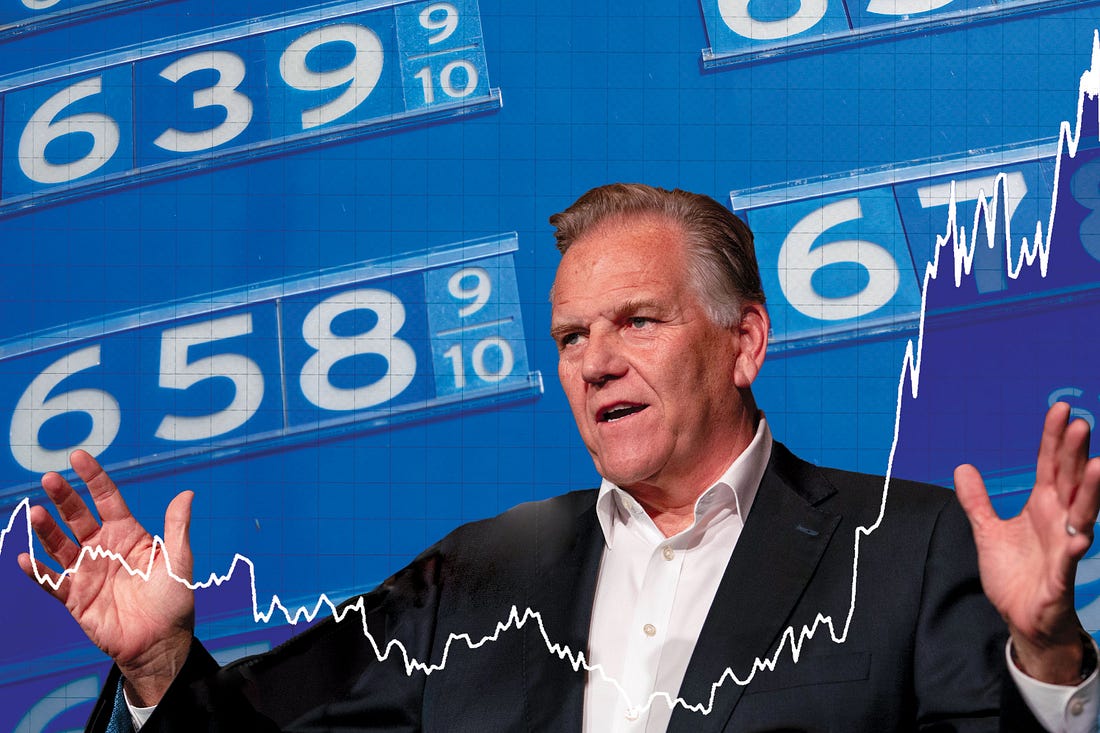
Rising gas prices often provide a convenient index for dissatisfaction with the current president, even if the increases have little to do with the administration’s policies.¹ When a war breaks out in major oil- and gas-producing regions, prices go up. When gas prices rise, so do the anxieties of political candidates who belong to the party in power. And this year, that includes many Republicans whose campaigns are crucial to maintaining a GOP Senate majority.
At the onset of the Trump administration’s unilateral military action (war) against Iran, gas prices in the United States skyrocketed, which immediately spooked Republicans concerned with holding on to their Senate majority. In the two months since the opening of hostilities, prices have fluctuated in some states while continuing to climb in others, with those around the Great Lakes seeing particularly challenging increases.
“We’re gonna be fine, we got plenty of oil,” Mike Rogers, a Republican candidate for Senate in Michigan, said in March. “You’ll get your oil, because we’re going to pump our oil right here in America, and we got plenty.”
Six weeks later, though, GasBuddy’s Patrick De Haan reported gas prices leaping upward in several middle-American states. In Rogers’s Michigan, they went up 88 cents. In Ohio, they climbed 94 cents. In Wisconsin, 33 cents. And in Indiana, prices grew by a calamitous dollar and nine cents.²
On Thursday, Rogers addressed the issue once again. When Newsmax host Ed Henry asked the candidate, “Are you nervous . . . about these stubbornly high gas prices?” Rogers finally acknowledged the reality of higher costs at the pump:
Listen, high prices of anything hurt people in Michigan. . . . Iran is about stopping their nuclear program, stopping their ballistic missile program so they can’t hurt others. I think most Americans are there. We all want this to come to a quick end—I think including the president of the United States. The president’s also taking really direct actions to try to bring those prices down and I support those actions to bring those prices down. I’ll tell you this, Ed. I get around and talk to voters all around this state. The main thing about affordability is they do not trust Democrats.
Well, Rogers sure doesn’t trust Democrats on affordability, at least. That might be why he framed the situation so differently when gas prices surged to four dollars per gallon during the Joe Biden administration.
“I’m not sure we can survive $3.99 a gallon going forward,” Rogers said in a 2024 video campaigning against Democrat Elissa Slotkin. “Listen, the [Democratic] agenda moving forward on gas prices is only gonna make that worse. We must get America back on track.”
The national average price per gallon now sits at just under $4.50 per gallon, according to AAA. In Rogers’s Michigan, it’s over $4.80 per gallon.
Sen. John Cornyn, who is hanging by a thread in the Republican primary for his long-held Texas Senate seat, told me in March that on the subject of higher fuel prices, “we gotta compare that to the threat of a nuclear Iran.” Within that frame of reference, he seemed untroubled by his constituents’ pain at the pump: “I would say it’s a small price to pay to avoid a nuclear weapon in the hands of the number-one state sponsor of terrorism.”
However, Cornyn quickly acknowledged that Republicans aren’t doing a very good job of helping everyone else see things the way they do.
“I think we have to do a better job of explaining it,” he said. “But I think if the American people understood, they would certainly agree that a nuclear Iran is a terrible idea.”
In Ohio, where gas prices are hovering above $4.80 per gallon, Republican Sen. Jon Husted has been largely silent on the issue. His Democratic opponent, former Sen. Sherrod Brown, has been slamming him over his reticence.
“It’s clear this war is hurting people financially and in other ways. There’s no end in sight. [Republicans] have no idea how to end this war. They didn’t plan anything,” Brown said at a campaign event last week. “Husted hasn’t raised one voice against this war or any idea about how to end it.”
Another battleground-state Republican who has been avoiding the subject is Sen. Susan Collins (R-Maine). While Collins said in mid-March that she hoped the Iran war effort would be “both brief and successful,” her stock portfolio has benefited from the protracted engagement: It includes oil and natural gas investment