Policy changes, but facts endure. AP delivers accurate, fact-based journalism to keep the world informed in every administration. Support independent reporting today. Donate. |
|
|
By Holly Meyer and David Crary |
|
| |
|
By Holly Meyer and David Crary |
|
| |
|
Greetings, World of Faith readers,
This week, we look at the latest twists in Israel's long-running debate over whether ultra-Orthodox men should be exempt from military service. We update the status of a traditionalist Catholic society whose leaders have been excommunicated. And we catch up with the Buddhist monk who strode into the global spotlight while leading a recent 15-week Walk for Peace across the southeastern U.S. |
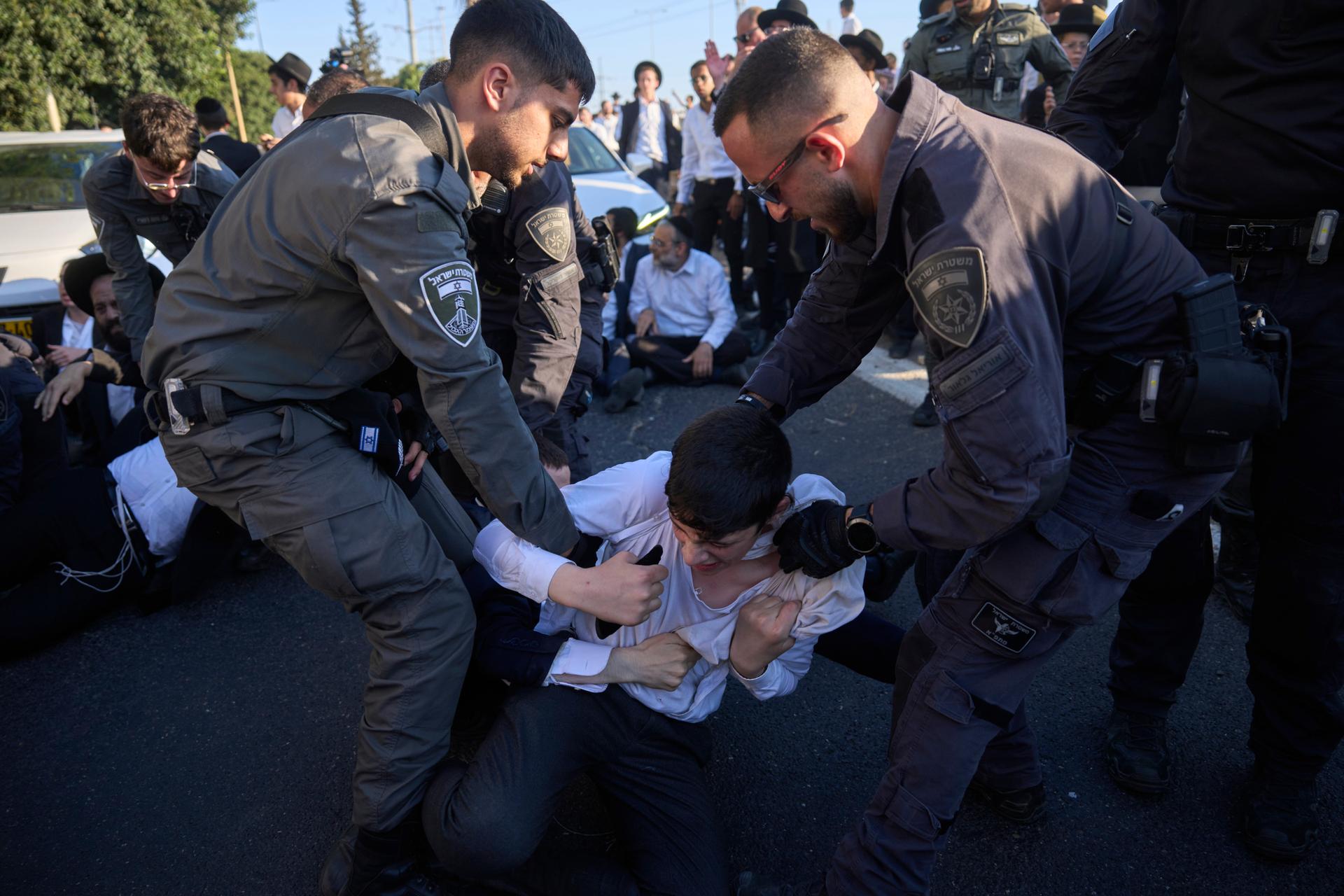
Israeli border police officers move ultra-Orthodox Jewish men blocking a highway during a protest against army recruitment in Bnei Brak, Israel. (AP Photo/Ohad Zwigenberg) |
Israeli parliament approves laws to enshrine exemption of ultra-Orthodox men from military service
|
The Knesset. Israel's parliament, has passed two laws that will effectively allow the continued exemption of ultra-Orthodox men from serving in the military. The legislation freezes the arrests of ultra-Orthodox draft dodgers and enshrines the Torah, Judaism's most sacred text, as a “foundational value” of the state. Read more.
|
|
|
-
The move — after marathon Knesset sessions earlier this week — comes as Israel's military faces troop shortages.
-
The Knesset is heading into a summer recess ahead of elections in the fall. Prime Minister Benjamin Netanyahu is eager to secure political support from the ultra-Orthodox for the elections, which will also serve as a referendum on his wartime leadership.
-
Many Israelis have tired of the longstanding system that allowed ultra-Orthodox men to avoid service. Each year, roughly 13,000 ultra-Orthodox men reach the conscription age of 18, but less than 10% enlist, according to a parliamentary committee.
|
|
|
In schism, traditionalist group carries on as bishops steer Catholics to Rome-aligned parishes |
For traditionalist Catholics who worship at churches affiliated with the breakaway Society of St. Pius X, Sunday Mass now comes with an extraordinary question. Their priests and bishops have been excommunicated after the fringe movement on the Catholic right committed what the Vatican considers one of the faith's gravest crimes: rupturing church unity by consecrating bishops without the pope’s consent. Read more.
|
|
|
-
Several bishops are urging Catholics in their dioceses not to attend the society’s local worship services or participate in other activities. Instead, the faithful — including those who want to attend Mass in the old Latin Rite — are being directed to churches fully aligned with Rome
-
The society, known as SSPX, sees itself as preserving tradition and has appealed the Vatican decree. Some members remain loyal, while others face a crisis of conscience.
-
SSPX was founded in opposition to the modernizing reforms of the Second Vatican Council, which it considers rife with heresies. The council revolutionized the Catholic Church’s relations with other faiths and allowed Mass to be celebrated in the vernacular rather than Latin
|
|
|
How a 2,300-mile Walk for Peace thrust a Texas monk and his dog into the spotlight |
Earlier this year, the Venerable Bhikkhu Pannakara, a Buddhist monk from Texas, led a Walk for Peace with an international group of monks and his rescue dog, Aloka. The 2,300-mile journey started in Fort Worth and ended in Washington. Pannakara’s discourses on mindfulness and message of nurturing inner peace drew large crowds. Millions from around the world followed online. Read more.
|
|
|
-
As part of his Theravada Buddhist practice, Pannakara follows “Vinaya” – a strict code of monastic rules. That means no social media accounts, personal possessions or handling money, and the practice of celibacy and modesty.
-
He doesn't eat after noon and generally sleeps sitting up. That is not mandatory for Theravada monks, but adopted by some as an ascetic practice to deepen mindfulness.
- Pannakara was born in Vietnam, in 1981 in a family he says was Buddhist in “name only.” He immigrated to the U.S. in 1997 and graduated with a technology degree from the University of Texas at Arlington.
|
|
|
|