Watch the inside FMU preview: blood chemistry, DUTCH testing, and the physical exam..
Dear Colleague and Friend,
Before you read the details below, I recorded a 24-minute inside preview for you.
I wanted you to see, not just hear about, the depth of what is included inside FMU.
In this walkthrough, I give you a controlled look at:
The FMU Comprehensive Blood
Chemistry Certification™
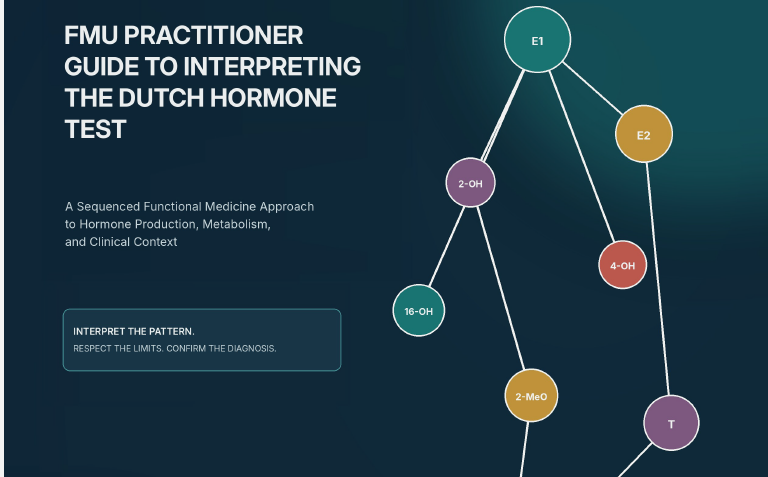
How FMU approaches advanced testing, including a DUTCH test example
The FMU Functional Medicine Physical Exam Certification™
I also show brief lesson previews so you can see that these are not light bonuses or simple add-ons. These are substantial clinical training systems.
I am not showing the full curriculum, full teaching materials, or proprietary interpretation tools, but I do want you to see
enough to understand the depth, structure, and clinical seriousness of what students receive inside FMU.
Because in clinical practice, the problem is not usually that clinicians have too
little information.
Very often, the problem is that they have more information than they know how to organize.
A blood chemistry panel gives
information. A DUTCH test gives information. A stool test gives information. A physical exam gives information.
But information does not organize itself.
The deeper clinical question is:
How do these findings fit together — and which finding should actually guide the next decision?
That is where FMU is different.
FMU teaches students how to use labs, advanced testing, and exam findings inside a larger clinical operating system.
Not as isolated
data points.
Not as disconnected reports.
Not as more “things to fix.”
But as part of a structured way to ask:
What pattern is emerging? Which findings belong together? Which findings confirm each other? Which findings are safety concerns? Which findings should be monitored? Which findings should change the next clinical decision?
And which findings are real — but not first?
That is why I keep saying:
Functional Medicine gave us the tools. Sequenced Functional Medicine™ teaches the clinical order of using them.
FMU
Comprehensive Blood Chemistry Certification™
Most clinicians are taught to read bloodwork as:
normal vs. abnormal.
That matters.
But FMU teaches students to go further.
Inside the FMU Comprehensive Blood Chemistry Certification™, students learn how to connect blood markers into one coherent clinical story — so labs do not become another
pile of disconnected data.
Students learn how to recognize patterns, confirm findings with companion markers, identify early physiologic drift, respect safety and referral thresholds, and use bloodwork as part of a larger clinical decision-making system.
The goal is not simply to know what AST means, what albumin means, what ferritin means, or what fasting insulin means.
The goal is to understand how those markers relate to each other.
Are they
connected? Is this an isolated finding or part of a broader pattern? Which marker may be primary? Which may be secondary or compensatory? Which finding deserves
attention first? Which finding should be monitored, expanded, sequenced, or referred?
That is how bloodwork becomes a clinical compass — not more
noise.
Included at no additional tuition does not mean lightweight.
This certification is being developed as a substantial standalone certification program and, when offered separately, is expected to have its own separate
tuition range of $1,895 to $2,495. During this FMU enrollment, it is included at no additional tuition because we believe blood chemistry belongs at the center of serious Functional Medicine training.
How FMU Interprets Advanced Testing
FMU also teaches students how to think through
advanced testing.
That includes tests such as hormone panels, stool testing, organic acids, toxin-related testing, nutrient testing, and other specialty evaluations.
And one example I want to highlight is the DUTCH test.
A test like DUTCH can provide
valuable information about hormone patterns, cortisol rhythm, estrogen metabolism, and related biochemical pathways.
But the FMU question is not simply:
“What does the test show?”
The deeper question is:
“How should this test change the next clinical decision?”
That is the
difference.
Advanced testing can be powerful, but only when it is interpreted in context:
What does the patient’s history show? What does the bloodwork suggest? What does the physical exam reveal? What symptoms are most clinically relevant? What is the patient ready to
tolerate? What must be addressed first? What should wait?
FMU teaches students not to treat advanced testing as a pile of isolated markers.
We teach students to ask whether the test result is decision-changing.
Because more testing does not automatically create more clarity.
Sometimes more testing simply creates more possible directions.
FMU helps
students learn how to interpret advanced testing inside a clinical sequence — so the test supports better decision-making rather than adding more overwhelm.
FMU Functional Medicine Physical Exam Certification™
The FMU Functional Medicine Physical Exam Certification™ is not a brief overview or a simple add-on.
It is a substantial, sequencing-based physical examination training system designed to help clinicians use the exam as a clinical decision tool — not just a checklist.
Students learn how to identify readiness, rate-limiters, dominant patterns, clinical safety issues, red/yellow flags, referral triggers,
and the appropriate order of care.
The certification is organized around 40 clinical lessons, 6 integrated modules, and 1 sequencing-based certification with the core promise: know what to do first, what to do next, and what to delay.
That matters because the physical exam can reveal things a lab report may not fully show.
It can help the clinician ask:
Is this patient stable enough for the next step? Are there red or yellow flags that require caution or referral? Is the patient showing signs of low reserve, poor regulation, or limited capacity? Does the exam support the same pattern suggested by the history and
labs? Should care advance, pause, simplify, or be redirected?
That is why FMU teaches the physical exam inside Sequenced Functional Medicine™.
The exam is not just about collecting findings.
It is about improving clinical judgment.
Included at no additional tuition does not mean basic. This certification is being developed as a substantial standalone
certification program and, when offered separately, is expected to have its own separate tuition range of $1,895 to $2,495. During this FMU enrollment, it is included at no additional tuition because we believe the physical exam belongs inside serious Functional Medicine education.
The FMU Difference
Blood chemistry gives you data.
Advanced testing gives you data.
The physical exam gives you data.
But FMU teaches students how to organize that data into clearer
clinical decisions.
That is the difference.
Inside FMU, you are not simply learning:
What does this marker mean?
You are learning:
How does this marker fit into the whole case? Does this finding confirm the pattern? Does this test result change the next decision? Does the patient have the capacity for the intervention being considered? What should
happen first? What should wait? What should be monitored, expanded, simplified, or referred
That is what makes FMU practical.
It is comprehensive, but it is organized.
It is detailed, but it is designed to simplify clinical thinking.
This is not less Functional
Medicine.
This is Functional Medicine with clinical order.
Enrollment for the next FMU class is now open.
If you want Functional Medicine training that includes the foundation, blood chemistry, advanced testing interpretation, physical exam training, clinical sequencing, and practical decision-making, FMU was built for that.
To your clinical excellence, Ronald Grisanti, D.C., D.A.B.C.O., D.A.C.B.N.,
M.S., DIANM, CFMP Founder, Functional Medicine University
P.S. More data does not automatically create more clarity. FMU teaches students how to connect bloodwork, advanced testing, and physical exam findings into a more organized clinical picture — so the next decision becomes
clearer, not more confusing.