| | In today’s edition: Confusion over the status of US-Iran talks, and Saudi Aramco profits from the wa͏ ͏ ͏ ͏ ͏ ͏ |
| |  | Gulf |  |
| |
|
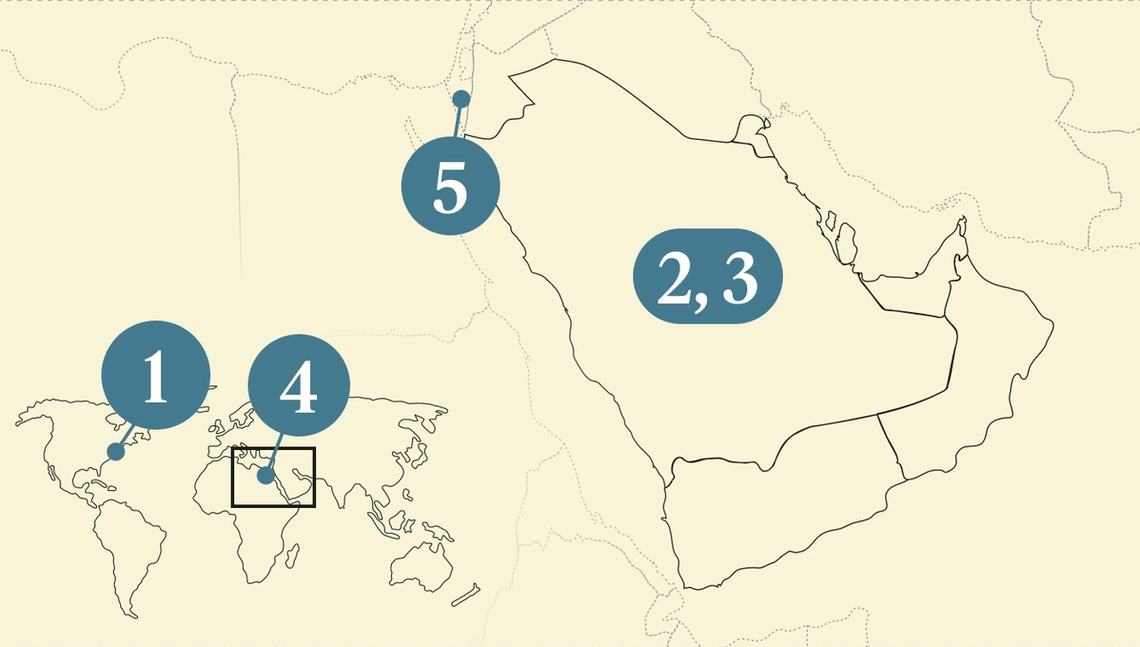 - Trump’s latest final warning
- Riyadh’s regional alliance
- Aramco earnings soar
- KKR sees infra opportunity
- Israel’s Gulf defense push
 Saudi fashion finds a new London home. |
|
Trump gives Iran another ‘last chance’ |
 Evelyn Hockstein/Reuters Evelyn Hockstein/ReutersUS President Donald Trump is back in the bombast phase of his Iran playbook, saying talks with Tehran were “a last chance” for the regime. Iran denied negotiations are underway, but it has been speaking to Omani, Qatari, and Saudi officials, all of whom could be sharing messages with Washington. Tough rhetoric has been a hallmark of Trump’s approach, alongside phases of bombing and then backing down to allow for diplomacy; the way he regularly cycles through each raises questions about the US strategy — or lack thereof — to end the conflict. Washington’s counterparts in Tehran have a firmer strategy centered on “resistance,” but there are signs of disagreement within the regime. Hardliners appear firmly in control, but occasional political flare-ups show Islamic Republic politics are not monolithic. The latest internal rift forced the Iranian president’s spokesman to deny that his boss had resigned, blaming the speculation on those who lost the last election. Against that backdrop, others continue to work on their own arrangements, including Saudi Arabia’s Red Sea security initiative, and its emerging alliance with Egypt, Pakistan, and Türkiye. — Dominic Dudley |
|
Riyadh forges a new regional alliance |
 Pakistan’s Prime Minister Office/Handout via Reuters Pakistan’s Prime Minister Office/Handout via ReutersIncreasing security cooperation between Saudi Arabia, Egypt, Pakistan, and Türkiye could become the nucleus of a wider group, or just a framework for ad hoc coordination. In either case, it may help to reshape the regional order, writes the International Crisis Group’s Yasmine Farouk. The “Regional Four” group has emerged from shared concerns about Israel’s military actions, but the on/off rift between Saudi Arabia and the UAE has also been a factor: Abu Dhabi has its own emerging alliance with Israel and India. Other Gulf countries will have to try to avoid being drawn into one camp or the other. The R4 countries’ interests are not perfectly aligned, and they differ in terms of threat perceptions and their willingness or ability to act in response. They also rely on US military muscle and technology to varying degrees. The real test will be if they can help bring the Iran war to an end. |
|
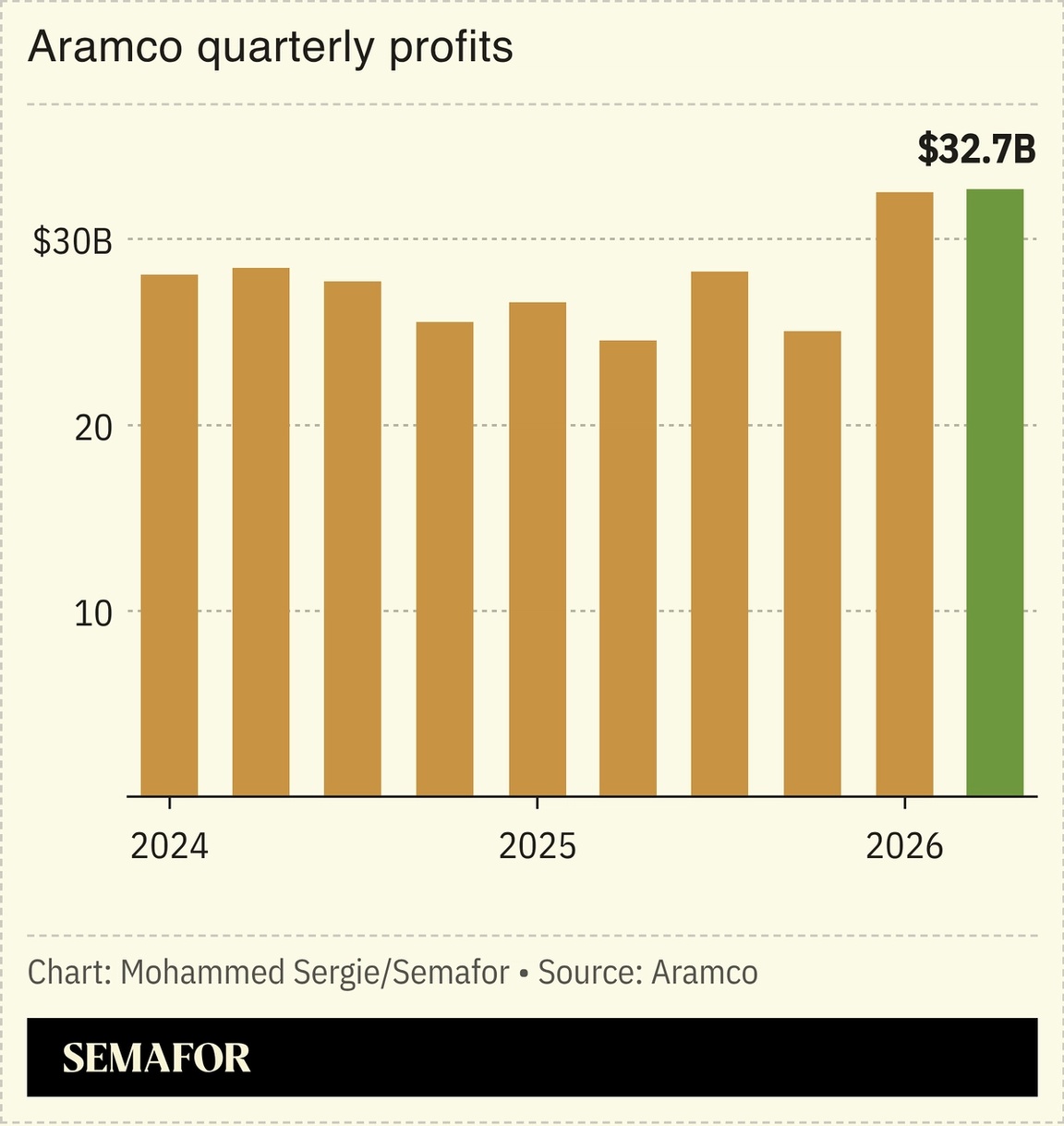 Saudi Aramco’s second-quarter profit rose 33% from a year earlier, as higher oil prices and strong refining margins offset lower export volumes during the US-Iran war. Decades of investment in pipelines, storage, and Red Sea export terminals helped the company to keep crude flowing despite disruptions to the Strait of Hormuz, Houthi threats in the Bab el-Mandeb Strait, and attacks on Saudi energy facilities. The performance allowed Aramco to maintain its $21.9 billion base dividend, providing a critical boost to the Saudi government, which owns about 98% of Aramco and receives about 55% of its revenue from oil. Chief Executive Amin Nasser said in an analyst call that Aramco was exploring ways to expand its East-West pipeline and identify other export routes to increase “optionality” against future disruptions. He expects oil demand to rise by about 2 million barrels a day in the second half, as countries look to replenish stockpiles depleted during the war. — Mohammed Sergie |
|
KKR bullish on Gulf infrastructure deals |
 Fred Greaves/Reuters Fred Greaves/ReutersKKR closed a $19.2 billion global infrastructure fund, some of which is earmarked to address the Gulf’s growing need for more resilient energy and digital build-outs. The private equity giant is already pouring billions into data centers in the Gulf, committing $5 billion across the Middle East over the past 18 months. Its head of Middle East investing said the new fund will “support the region’s next phase of growth,” in a statement to Semafor. Last week KKR and Blackstone signed a roughly $16 billion lease on Kuwait’s national pipeline network. Only months after Iranian drones struck AWS data centers in the UAE and Bahrain, casting doubt on whether the region’s big bet on digital infrastructure could pay off, KKR’s moves are a vote of confidence. Still, the bulk of KKR’s new vehicle is bound for North American and European investments. — Kelsey Warner |
|
Israel’s deep Abraham Accord defense ties |
 Arnd Wiegmann/Reuters Arnd Wiegmann/ReutersLeaked emails allegedly reveal a far bigger market for Israeli weapons in Abraham Accord countries. Elbit Systems, Israel’s largest defense contractor, has been linked to the potential sale of more than $1 billion worth of drones to the UAE. Israeli newspaper Haaretz reported that internal documents from the company show that Abu Dhabi requested advanced drones following deadly Houthi attacks in 2022. It is not clear which deals went through, but Elbit reportedly agreed a $2.3 billion contract last November — one of Israel’s largest ever — with the UAE. Israeli defense companies have delivered around $9 billion in weapons and systems to Bahrain, Morocco, and the UAE since 2021, and have also been linked to sales in other Arab countries through third parties. Israel sent Iron Dome batteries and crews to the UAE during the Iran war, which the US called a “benefit” of the Abraham Accords. |
|
 Sports- The NBA will not play preseason games in the Gulf this year. The league was reportedly considering splitting the exhibition matches between Doha and Abu Dhabi, which had hosted the NBA over the past four years. — ESPN
Stock market- Dairy and juice company Dandy set a price for its upcoming listing on the Qatar Stock Exchange, valuing it at 515 million riyals ($141 million).
Tech- Saudi Arabia’s AI champion HUMAIN made its first bet on a homegrown company, taking a stake in enterprise AI firm MOZN, which develops tools for banks and government. The kingdom aims to build up local alternatives to foreign tech.
Wealth- Sharia law sets out clear rules for how Muslims should manage their financial affairs, from prohibiting usury to stipulating how inheritance is divided. But some Gulf families, uncomfortable with the unequal split of assets between daughters and sons, have turned to lawyers in England for “sharia-lite” workarounds that are more equitable. — Financial Times
|
|
 theofficialselfridges/Instagram theofficialselfridges/InstagramA corner of Selfridges has gone Saudi for the summer. The high-end London department store is hosting “Saudi: Sky’s the Limit” until September, gathering more than 20 Saudi fashion, beauty, and food brands. The list includes 1886, a streetwear label dreamed up by two Saudi students in their London dorm and named for their room numbers. Saudi Arabia’s sovereign wealth fund owns 40% of Selfridges. Gulf money has bought up numerous London landmarks over the years, including Harrods, the Shard, and some of the city’s most expensive hotels, but the Gulf has few brands of its own to stock them with. Saudi Arabia spent the past decade building its own — including Milaf, PIF’s dates-and-food company, and Kayanee, an activewear label — then bought somewhere to put them. — Manal Albarakati |
|
Item 5 in the Aug. 3 briefing, ‘Abu Dhabi gives up Murban,’ incorrectly framed ADNOC’s decision to transition from its Murban crude benchmark as a failure of the benchmark itself. The company said it made the change to price cargoes based on the month of loading to more closely reflect market conditions. |
|
| |  | | | You’re receiving this email because you signed up for briefings from Semafor. |
|


