Hello,
Today’s newsletter is all about the wildfires, heatwaves and drought gripping the Northern Hemisphere. The wildfires raging in the United States on the outskirts of Spokane, Washington, have destroyed at least 700 buildings and forced tens of thousands of people to flee their homes, officials said.
The Spokane Area Fire, which includes three separate blazes, was threatening the areas under evacuation orders, Spokane Fire Chief Tom Williams told Reuters.
The blazes ranked as the top firefighting priority in the U.S., including the drought-parched Pacific Northwest, where dozens of major wildfires have burned for weeks, degrading air quality across a wide region.
Before we get into more information around the wildfires, here are some environmental stories on my radar: |
|
|
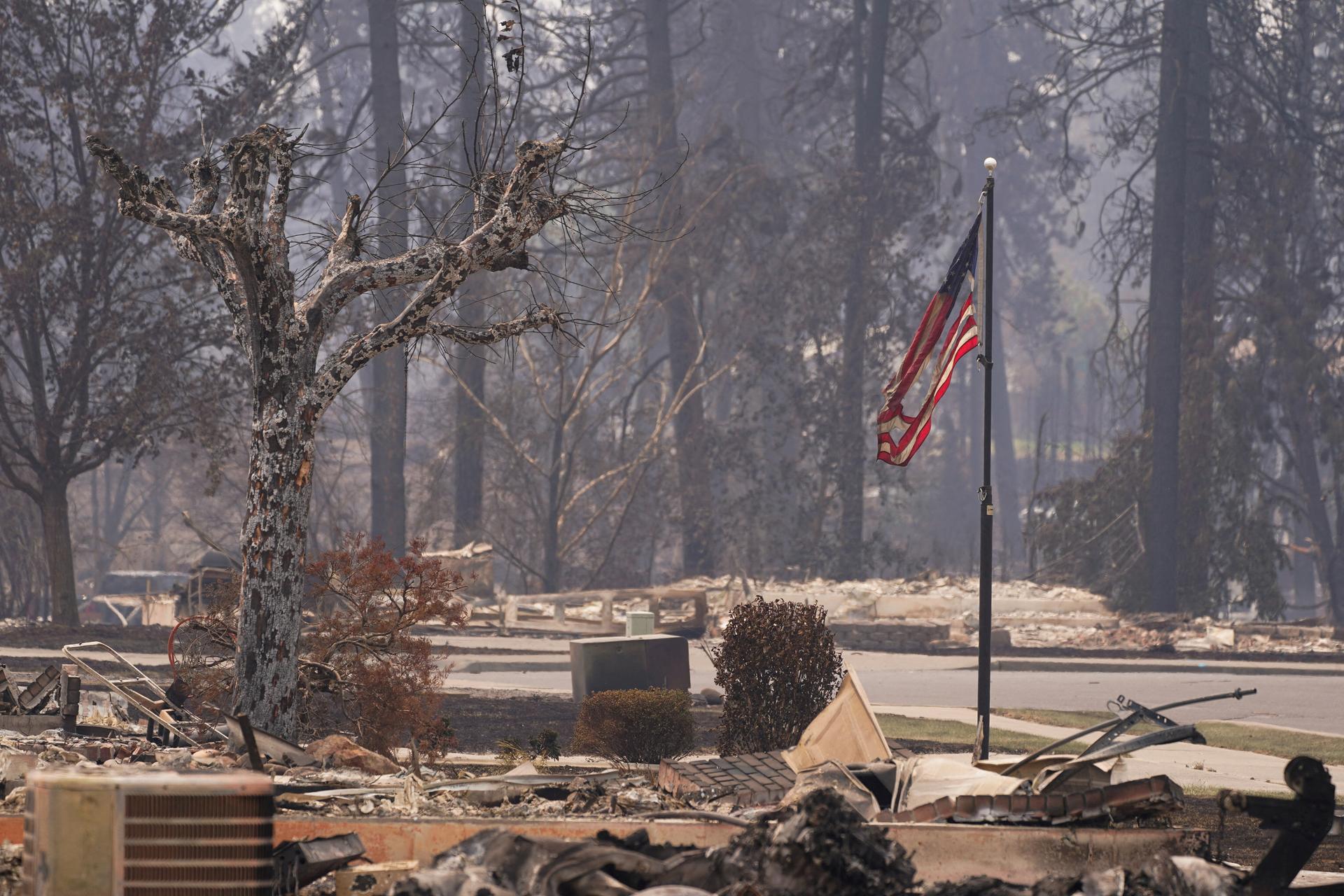
A torn American flag flutters among incinerated neigbourhood in the Old Trails Fire, in Spokane, Washington, U.S. REUTERS/David Ryder |
‘The worst natural disaster in our region’
|
Enormous palls of smoke billowed into the sky north of the city, as flames devoured forest land 6 miles (10 km) from Spokane's downtown.
The fires have burnt more than 8,000 acres (3,200 hectares) since erupting on Saturday on the northern fringe of the city, home to about 230,000 residents west of the Rocky Mountain foothills near the Idaho border.
No injuries or fatalities have been reported so far, according to Benjamin Cossel, a spokesperson for the incident command center. "There's a high probability that will change in the coming days" as flames subside and search teams are able to reach devastated communities still inaccessible due to extreme fire activity.
Spokane Mayor Lisa Brown called it "the worst natural disaster our region has faced." Washington Governor Bob Ferguson said he had spoken with U.S. President Donald Trump on Sunday and requested assistance from the Federal Emergency Management Agency. The governor has declared a statewide emergency. |
|
|
|
‘We don't want to scare you’ |
Kami Fehlig, 58, was one of hundreds of area residents who fled for their lives before wind-driven flames engulfed their homes over the weekend. Picking through charred ruins of her house in search of keepsakes, Fehlig paused on Monday to recount how she and her husband watched in disbelief as fire jumped the narrow Spokane River and swept toward their parkside neighborhood in the city's northwest on Saturday.
"About 30 minutes before it jumped the river, my husband and I were seeing how bad it was, and we told the kids, 'We don't want to scare you, but we think you should start preparing to grab some things.'" Only later did they learn that their house, as well as the family's chicken coop, had burned to the ground, along with much of their surrounding community.
At least 700 structures have gone up in flames, mostly in residential areas, and aerial infrared surveys showed that possibly another 400 buildings, including homes, had been damaged or destroyed, Cossel said. The cause of the blazes was under investigation. |
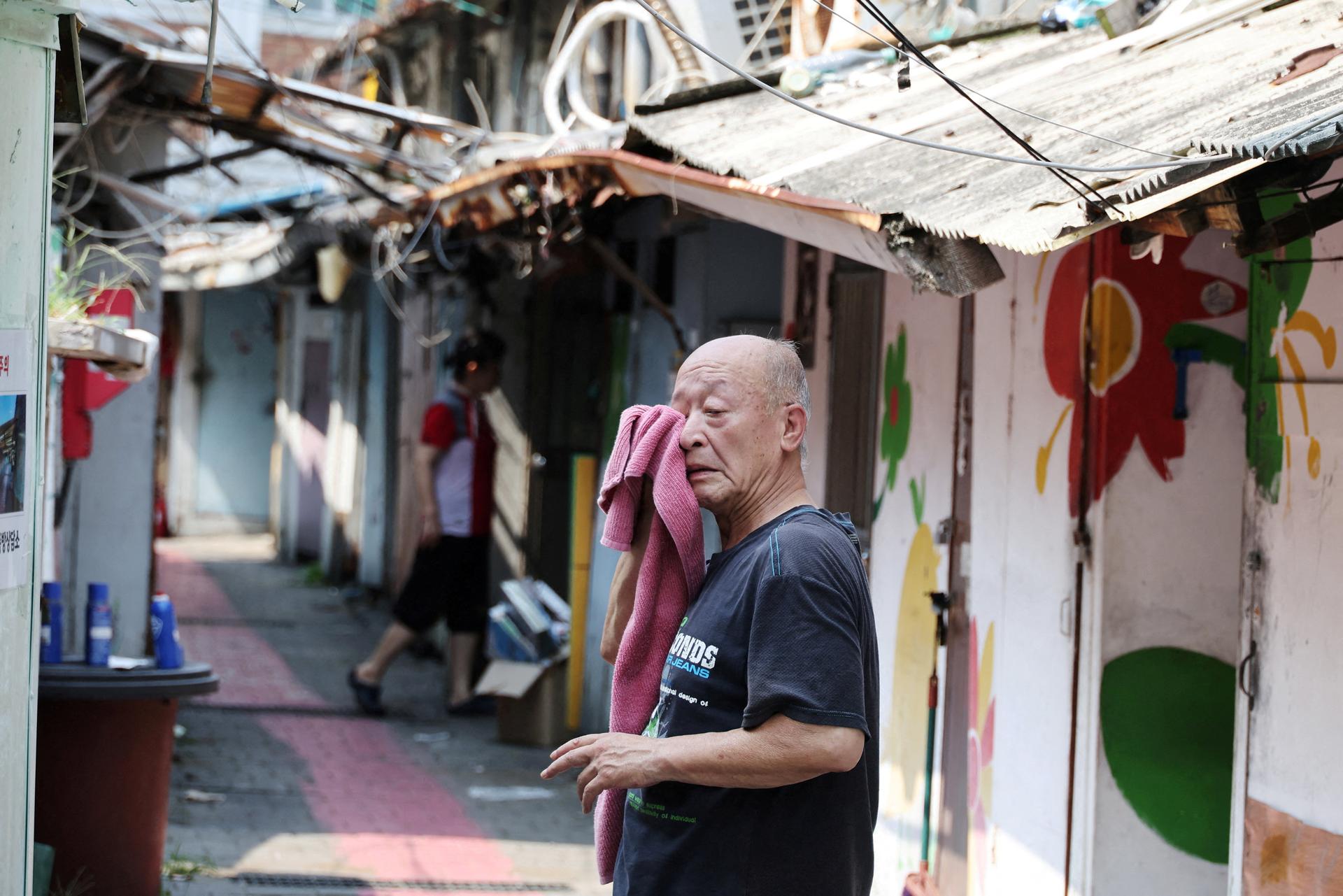
A man wipes off sweat at a jjokbang village which is a tiny single-room housing district, during the first-ever severe heatwave warning in Seoul, South Korea. REUTERS/Kim Hong-Ji |
-
Korea heatwave: A record heatwave has sent temperatures soaring across the Korean Peninsula, causing 19 deaths in South Korea. North Korean state media also reported temperatures approaching 40 degrees Celsius (104 degrees Fahrenheit) in parts of the country. South Korea's weather agency warned temperatures could rise further in western regions this week and said the heatwave and tropical nights were likely to persist.
-
Romania water explosion: Romania blew up a rock outcrop to help redirect vital cooling water from the drought-hit Danube to clear the way for authorities to build a temporary dam which would send more water to the river channel where the last working nuclear reactor Cernavoda sits. The controlled blast underlines the scale of the crisis in Europe, where heat and drought have lowered river levels and raised concerns about water supplies.
-
Camping fires in France: Wildfire flames were bearing down on a campsite in southwest France, and police told camping ground manager Hadrien Folliot he had little time to remove roughly 1,200 holidaymakers. As French camping approaches its centenary, an industry that has shaped generations of family holidays finds itself increasingly exposed to the realities of a warming climate. Click here for the full Reuters article.
-
Greek wildfires: Hundreds of Greek firefighters battled a wildfire northwest of Athens throughout the weekend after blazes fanned by strong winds gutted homes, thousands of hectares of farmland and pine forests, and forced emergency evacuations by land and sea. Additionally, two people died on a firefighting helicopter on Sunday after their aircraft crashed in a mid-air brush with a second helicopter.
-
Seaweed invasion: Hotels across the Caribbean are facing a smelly seaweed problem. Sargassum – a foul-smelling brown seaweed – has floated across the ocean surface from the so-called Sargasso Sea in the North Atlantic to the Caribbean coastlines around popular tourist resorts. This has caused hotels to cut rates and invest millions of dollars in clearing up piles of the foul-smelling algae from their beaches, while governments and businesses look for solutions. Click here for the full story.
-
Lion heatstroke: Three female lions aged 3, 11 and 15, died of suspected heatstroke at Tokyo's Tama Zoological Park over the last week, the first heat-related deaths among the facility's lion population in its 62-year history. As temperatures in Tokyo spiked in mid-July, the majority of the zoo's 16 lions began losing their appetite and became lethargic to the point of requiring treatment, the zoo said.
|
|
|
|
Phil Duffy, chief scientist at a U.S.-based science-driven nonprofit, Spark Climate Solutions, shares his thoughts on rising global temperatures: "Over the past 25 years, Earth's energy imbalance – how much heat the planet absorbs rather than releasing into space – has more than doubled, meaning global warming is accelerating.
"Climate models show far smaller increases than observations do, suggesting the models policymakers and businesses rely on may significantly underestimate future warming.
"Understanding what is driving these dynamics is an urgent scientific priority.
"Human-caused greenhouse gas emissions and reduced particulate pollution both contribute, but more research is needed – and the scientific community studying Earth’s energy imbalance remains small and under-resourced.
"Satellite monitoring is also at risk. The U.S. once operated six space-based monitoring instruments; only four remain, likely dropping to two within a year.
"NASA's Libera instrument is planned to launch next year, but the agency estimates a 75% chance of a data gap before 2040, which would severely limit our ability to track Earth's heat uptake and more accurately project future warming." |
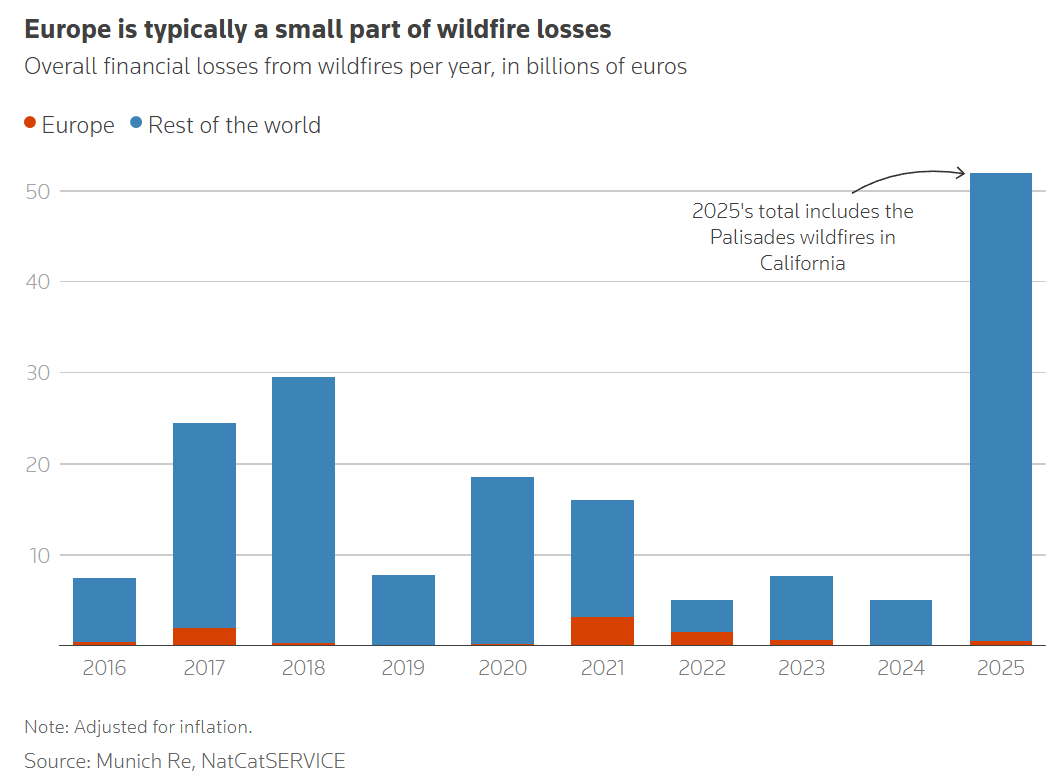
Climate insurance: The wildfires have renewed attention on Europe's "protection gap" – the difference between total losses from disasters and the amount covered by insurance. The European Central Bank and the European Union's insurance regulator have warned that only a quarter of losses from climate-related catastrophes between 1980 and 2024 were insured. Wildfire insurance is also less developed in Europe than in the United States. Click here for the full Reuters analysis.
|
|
|
|
|