Hello!
It’s all about climate adaptation in farming in today’s newsletter with a focus on new practices and techniques emerging in agriculture from Britain to Japan.
I had the pleasure of taking over my colleague Ross Kerber’s Sustainable Finance newsletter yesterday which centered on how the El Niño weather pattern and other climate events can affect food supply chains. Click here to catch up and subscribe.
Today’s newsletter follows on from that with a story based on Reuters interviews with people in banks, insurance groups, water companies, governments and major food groups such as McDonald's who are funding a shift in farming practices. I’ll also share an image-driven feature on farmers in Japan who are shifting work to mornings and nights as they try to beat more frequent and intense heatwaves.
Also on my radar today: |
|
|
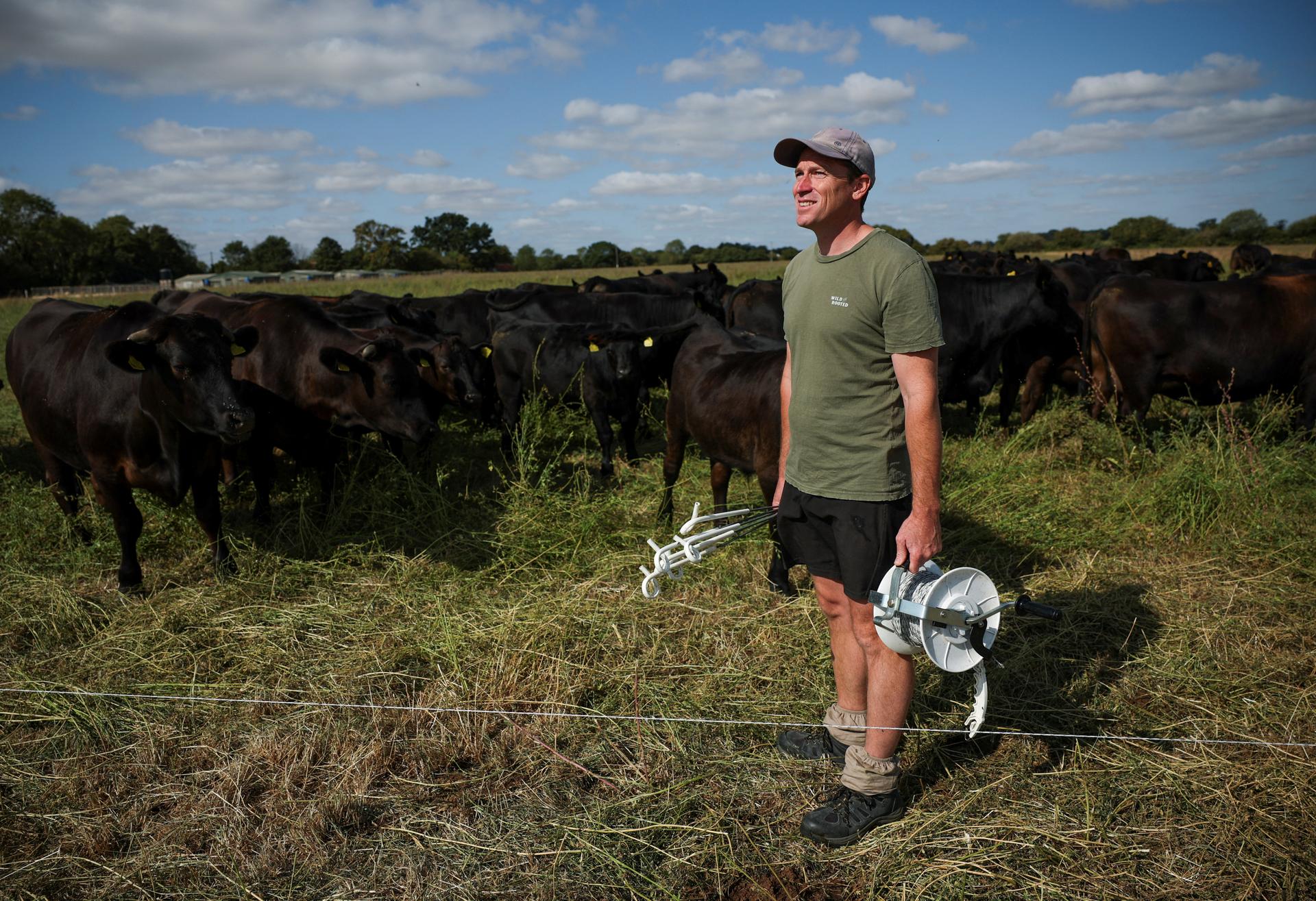
Cattle farmer Sam Squier poses for a photograph with his herd of Aberdeen Angus cows on a green pasture at Humphreys Farm, in Great Waltham, Chelmsford. REUTERS/Isabel Infantes |
‘What you can do in a dry year’ |
Meteorologists say they expect to declare Britain's summer, which officially ends on August 31, the hottest yet. And Europe as a whole has experienced more extreme warming this year than any other continent, with five heatwaves and far below average rainfall.
After its hottest June and driest July on record, almost three-quarters of England is officially in drought. Livestock and dairy farmers have reported poor grass growth, the UK's cereal harvest is set to be the worst since comparable records began in 1984, and fruit and vegetable growers have said production will be reduced, echoing warnings from across Europe.
The losses for farmers in the European Union and Britain from failed crops in the June heatwave could be up to €2.3 billion ($2.7 billion), according to the Energy and Climate Intelligence Unit. There are knock-on effects for inflation, which has already been driven higher by the increased energy and fertilizer costs linked to war in the Middle East. The only option, say the farmers themselves, is to adapt. "This year is a testament to what you can do in a dry year," Sam Squier, a beef farmer based in southeast England, said. "Our vision was to improve the soil structure and build resilience within our business, mitigating against both prolonged periods of dry hot weather and prolonged periods of wet weather," he added.
Squier said that his cattle, which carry genetic traits from Japanese Wagyu renowned for producing tender beef, graze on a mix of grasses, deep-rooting herbs and legumes, known as herbal leys. The grasses provide energy-rich feed, the nutrient-enhancing herbs help to control parasites and reduce the need for medication, while the legumes fix nitrogen in the soil, removing the need for artificial fertilizers.
The method is inspired by ancient practices and reflects decades-long efforts to introduce climate-resilient farming as governments and regulators across the world have sought to make supply chains less vulnerable. Click here to read the full Reuters analysis. |
|
|
|
Nocturnal farming in Japan |
Over in Japan, some farmers are rewriting the agrarian clock as increasingly intense heatwaves turn the nation’s summers into survival tests.
Once-busy midday hours are now avoided as a mortal threat, replaced by after-dark work to protect crops, livestock and themselves. Outside temperatures above 35 degrees Celsius (95 degrees Fahrenheit) can push greenhouse interiors above 40 C.
Japan is especially exposed: around 70% of its farmers are 65 or older, a population especially susceptible to heat stress, and high humidity amplifies the danger.
Click here for a beautifully photographed special report that showcases one Japanese farmer in particular, Motoaki Iijima, who shares his story about changing his routine after a part-time worker suffered heatstroke picking sunflowers in his greenhouse north of Tokyo.
Keep scrolling down for today’s governance-focused ‘Talking Points’ section that centres on executive accountability - with reports on polls on U.S. President Donald Trump’s personal wealth, the imprisonment of the CEO of China’s Evergrande, and the opening of a child privacy case involving Meta Platforms. |
U.S. President Donald Trump at a press conference with cryptocurrency executives in the Roosevelt Room at the White House in Washington, D.C., US. REUTERS/Kylie Cooper |
-
Trump crypto poll: A new Reuters/Ipsos poll found that a majority of Americans believe President Donald Trump and his family have inappropriately profited from cryptocurrency since his return to power and that his policy decisions are influenced by his private business dealings – a striking finding for a leader who pledged to clean up corruption in Washington. Trump earned more than $1.4 billion last year from his family's cryptocurrency ventures. Click here to read the full Reuters story.
-
China Evergrande scandal: Hui Ka Yan, once Asia's richest man and the founder of China Evergrande Group, the world's most-indebted property developer, was sentenced to life in prison in the southern city of Shenzhen. Hui pleaded guilty in April to eight charges, including misuse of funds, fundraising fraud, illegally taking public deposits, illegally extending loans, fraudulently issuing securities and bribery.
-
Meta child privacy case: Opening statements are underway in a landmark trial over claims that Meta Platforms misled the public about the safety of Instagram and Facebook for young users and violated child privacy laws. The states pushed for a single trial covering state consumer protection and federal privacy claims brought by 29 attorneys general, while Meta argued for a series of smaller trials grouping states that have similar laws.
-
U.S. migrant caregivers: Around 21,000 Haitians in the U.S. under Temporary Protected Status worked as caregivers and nursing assistants as of last year, serving around 77,000 patients, according to an analysis of U.S. census data by Philip Connor, a research fellow at Princeton University. Their abrupt removal from the healthcare industry has placed additional strain on a system already struggling to meet the needs of the fast-aging U.S. population. It also came as a shock to families that relied on them.
- Migrant women face harassment: Reuters spoke to some of the women who joined the mass crossing into Spain's North African enclave of Ceuta on July 30. They said that some men, also staying in the vicinity, are harassing them. Click here to read more.
|
|
|
|
Solange Bandiaky-Badji, president and coordinator of the Rights and Resources Initiative, shares her thoughts on the Conference of the Parties (COP17) to the United Nations Convention to Combat Desertification taking place this week in Mongolia: “COP17 must move beyond recognizing the importance of pastoralists and begin recognizing their rights.
“The conference is an opportunity to turn growing recognition into stronger protections for the estimated 500 million people worldwide who depend on pastoralism for their livelihoods. “That means protecting mobility; access to land and water; customary tenure; free, prior, and informed consent; and access to justice while ensuring that pastoralist women and youth have a meaningful role in decisions.
“Pastoralists should not be treated as a threat to rangelands. They are among the world’s most important partners in protecting biodiversity, restoring landscapes, and building climate resilience. “These communities play an essential role in managing rangelands, protecting biodiversity, and adapting to climate change. Yet many still face insecure land rights, restrictions on mobility, and limited representation in decisions affecting their territories.” |
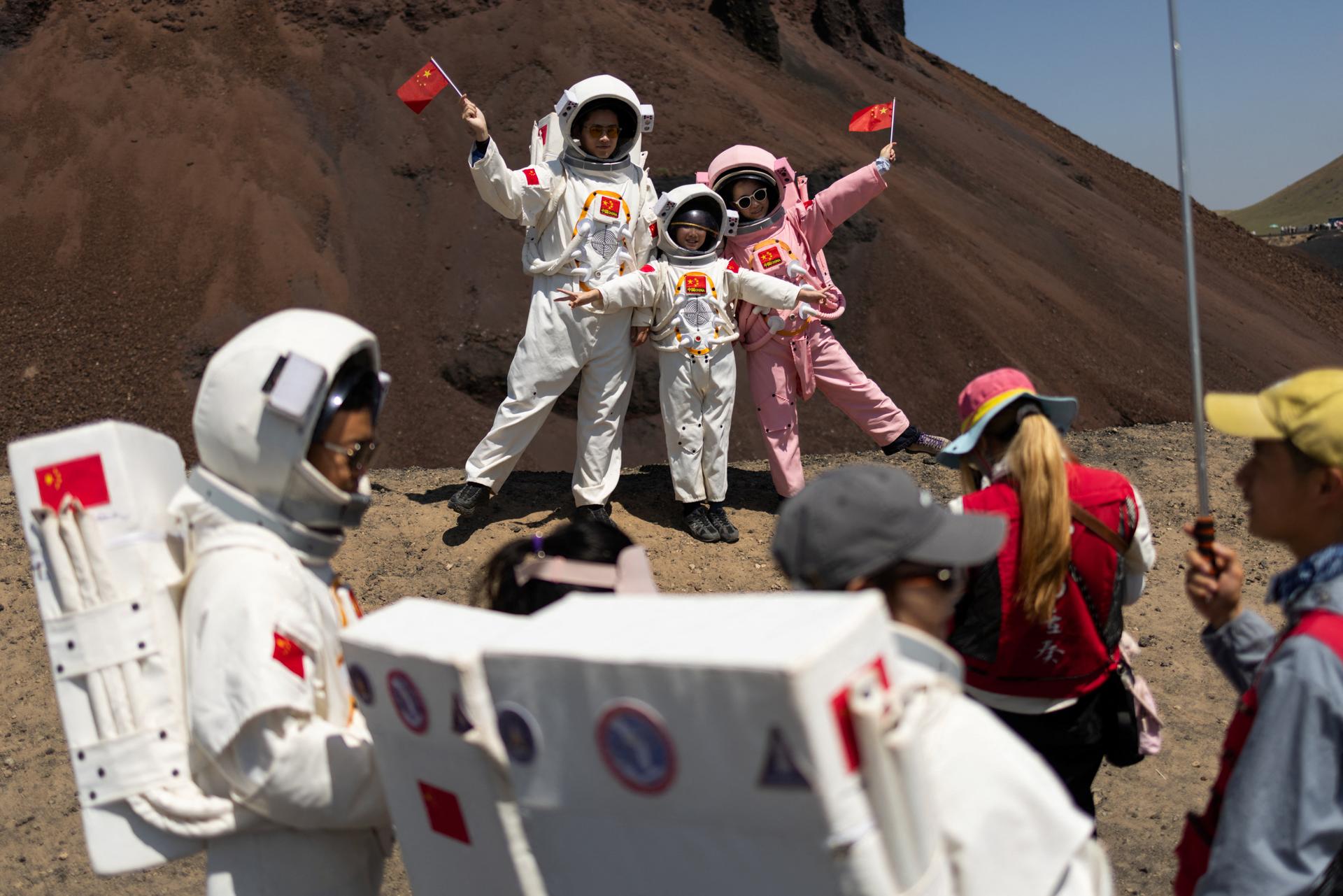
Visitors wearing astronaut costumes pose for pictures at the Wulanhada Volcano Geopark in Ulanqab, Inner Mongolia Autonomous Region, China. REUTERS/Maxim Shemetov |
Today’s spotlight focuses on a Reuters special report about how China’s space launches, once highly classified events in remote desert locations, have become public spectacles and a big draw for tourists - even when the missions do not always go as planned.
Coming attractions include the launch of a crewed moon landing by 2030 followed by a crewed mission to Mars. We’ve also got some fascinating robot photo-driven stories, so click here if you want to see more of China’s rising robot innovations. |
|
|
|
|