Eric Klinenberg
A professor of social science who writes about the environment
This May, my eighty-four-year-old Francophone father and his seventy-year-old wife realized a lifelong dream: they rented an apartment in Paris and moved there for a month of adventure and romance. A barrage of joyful photographs—Montmartre! Couscous! The Place des Vosges!—filled my inbox. Then I saw the forecast. France was about to experience a record-shattering heat wave, with ninety-degree weather, in a time of year that, for as long as anyone can remember, has always been lovely and mild.
When the heat arrived, my father, feeling ill and uncomfortable in a stuffy apartment (only a small fraction of Parisian apartments have air-conditioning), decided to end his trip early, returning to Chicago. Of course, the tens of millions of people who live in Western European cities do not have that option. They know, from the past few years of massively lethal heat waves—there were an estimated seventy thousand heat-related deaths in 2022, forty-eight thousand in 2023, sixty-three thousand in 2024—that global warming has already transformed the temperate European summer into a hotter, more dangerous season. Even so, 2026, which, thus far, has featured five lethal heat waves and a historic spate of destructive wildfires, has triggered alarm across the Continent, and beyond. A habitat, and, with it, a host of cultural traditions—Wimbledon, the Tour de France, strolling down La Rambla on a sunny afternoon—were at risk this year, and will be more so in the years to come.
I’ve been doing research on heat waves since 1995, when more than seven hundred people in Chicago died during a blistering week in July. This year, as the heat spread across Europe, I travelled to Milan, Barcelona, and Paris to learn, for a piece in this week’s issue, how cities are attempting to adapt. Switching from fossil fuels to renewable energy remains one of the best options for preventing catastrophic warming. Cities, including Paris and Barcelona, have notably reduced car traffic, but decarbonizing, at a moment when A.I. use is soaring and data centers are popping up everywhere, may be beyond their control. In recent years, however, architects, urban planners, and officials across Europe have been working urgently, and imaginatively, to lower the temperature of the landscape, redesigning twenty-first-century cities around three ancient forms of cooling: water, soil, and shade.
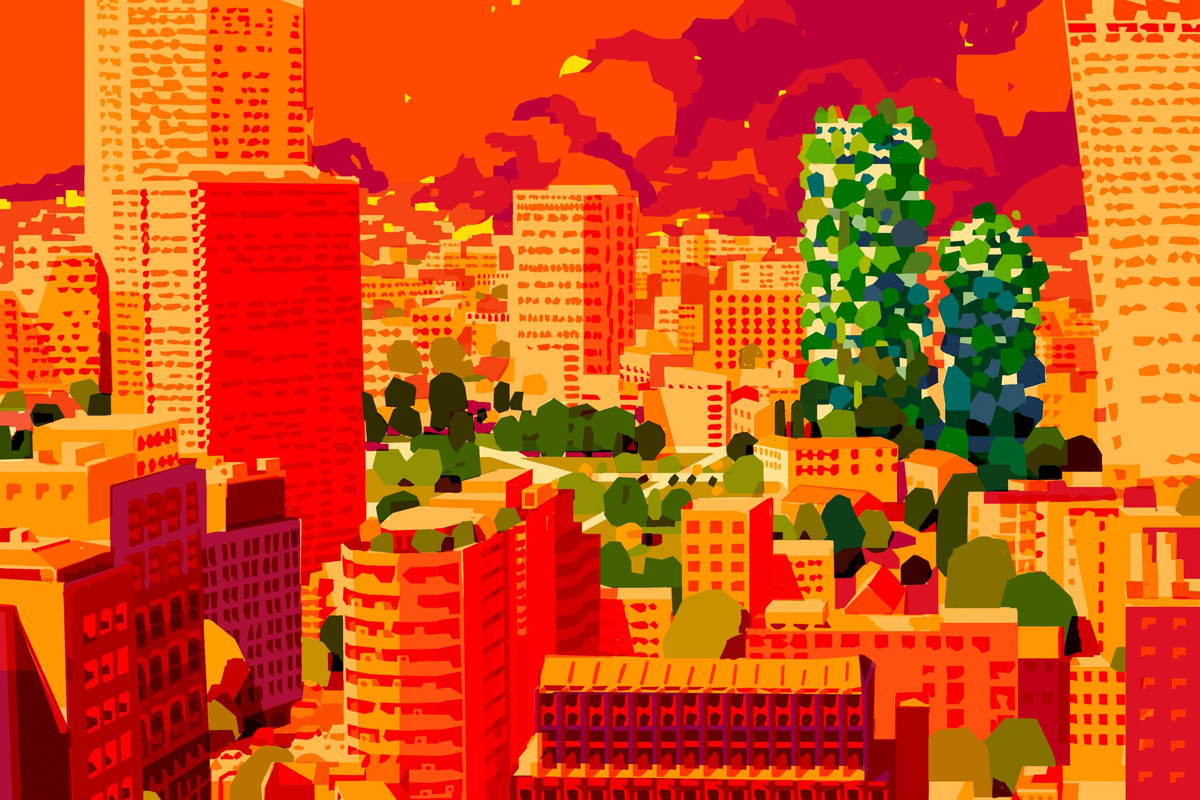
In Milan, I met Stefano Boeri, an architect best known for designing high-rise buildings he calls “vertical forests,” but whose more ambitious project, Forestami, aims to plant three million trees in the metropolis by 2030. In Barcelona, I found shade in tree-lined pedestrianized corridors, including Superblocks and Green Axes, and learned how city planners are greening “leftover” land—rooftops, empty lots, alleyways between buildings—to turn dead spaces into verdant social infrastructure. In Paris, the new mayor, Emmanuel Grégoire, lent me his Voltaire e-bike and toured me around an urban forest, misting station, and swimming areas, including a surprisingly popular one: the Seine. The projects are transformative, even inspiring, but they still may not be enough to protect life and preserve the joys of summer on a continent that’s warming at more than twice the global average, with regular outbursts of unbearable heat.