


The White House’s posture toward Russia is getting more bizarre all the time. On the one hand, Trump has promised to sign a sweeping package which—as Andrew wrote yesterday—would hit Russia’s elite with new sanctions and give Trump the ability to hit Russia’s energy customers with tariffs. And Russia is getting more reckless with attacks and plots that threaten to pull America and other Western countries deeper into the war.
And yet the New York Times reports today that Trump and his advisers are also discussing new “business deals” with Russia that could come even before the end of the war—the exact opposite philosophy of the one driving the sanctions package. All this time later, and Team Trump is still in the concepts-of-a-plan phase on Russia and Ukraine. Happy Friday.
|

Join Catherine Rampell and JVL for Receipts Live today at 12:30 p.m. EDT on Substack and YouTube.
 |
Lincoln, Gladstone, and Us
by William Kristol
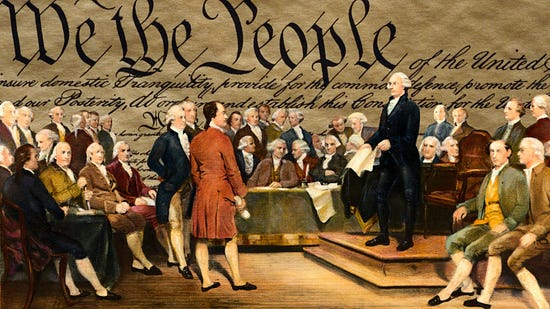
Yesterday, September 17, was Constitution Day. On that day in 1787, thirty-nine delegates to the Constitutional Convention in Philadelphia signed a new constitution for the United States of America. It was ratified less than a year later, on June 21, 1788, when New Hampshire became the ninth state to approve it, meeting the requirement set by Article VII of the Constitution itself.
The first elections under the new Constitution were held in the fall of 1788. The first Congress to convene under it was sworn in on March 4, 1789. The first president to be inaugurated under it was sworn in on April 30, 1789. And so the new government came into effect less than two years after the Constitutional Convention convened on May 25, 1787.
A consequential couple of years! And they’ve been followed by a consequential couple of centuries for this constitutional republic.
Today we still live under that Constitution—improved by twenty-seven amendments,¹ each ratified according to the procedures laid out in Article V of the original text. When he’s inaugurated, our president swears that he “will to the best of my ability, preserve, protect and defend the Constitution of the United States.” When they’re sworn in, our members of Congress take an oath to “support and defend the Constitution of the United States against all enemies, foreign and domestic,” and that they “will bear true faith and allegiance to the same.”
It’s our Constitution. We’re proud of it. We admire it. We honor it. We know it’s a great achievement. We understand that it’s served us well.
And yet we don’t much notice nor celebrate its anniversary. Constitution Day has never made it to the top tier of American holidays.
Which is actually fitting and proper. July 4th is the national holiday, celebrating the Declaration of Independence. The Declaration came first in time and comes first in importance.
In a note that he wrote shortly after his election as president in 1860, Abraham Lincoln sought to elucidate the relationship of the Declaration to the Constitution. Adapting the famous image from Proverbs 25:11—“A word fitly spoken is like apples of gold in pictures of silver”—Lincoln wrote that the Declaration is an “apple of gold” for us. The principle expressed in the Declaration, the principle of “Liberty to all,” Lincoln explained, “clears the path for all—gives hope to all—and, by consequence, enterprise, and industry to all.” Without that principle, Lincoln wrote, “we could not, I think, have secured our free government, and consequent prosperity.”
But a declaration, a principle, isn’t enough. It needs a workable government to protect and effectuate it. So, Lincoln continued,
The Union, and the Constitution, are the picture of silver, subsequently framed around it. The picture was made, not to conceal, or destroy the apple; but to adorn, and preserve it. The picture was made for the apple—not the apple for the picture.
Lincoln concluded his note: “So let us act, that neither picture, or apple shall ever be blurred, or bruised or broken.”
It’s not only Americans who have admired our Constitution. The great British Prime Minister William Ewart Gladstone wrote on the occasion of the centennial of its ratification that “the American Constitution is, so far as I can see, the most wonderful work ever struck off at a given time by the brain and purpose of man.”
Gladstone was a Liberal, probably the greatest Liberal prime minister. His praise is a reminder that constitutional government is and has always been a liberal cause.
Today, when the Constitution has been under an assault unprecedented in breadth or depth since the time of Lincoln, there is no cause more important than a renewal of liberal constitutionalism. There is no task more urgent than defending and strengthening our constitutional government. There’s no undertaking more critical than reconstructing the institutions, laws, and norms that make the Constitution effectual and effective. Our path forward requires a sober and imaginative liberal constitutionalism.
The Founders did it in 1787. We have their spirit to inspire us and their example to instruct us. There’s no reason we can’t do it today.