





 |
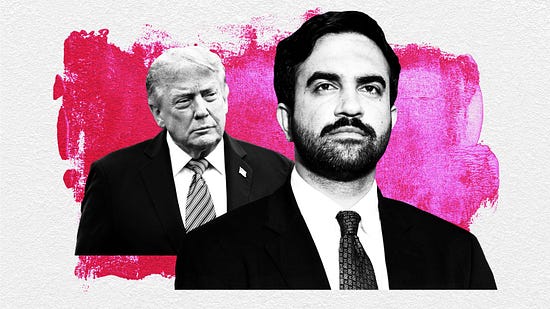
THE TRUMP–MAMDANI BROMANCE is officially over.
The unlikely bonhomie between the president and New York City’s mayor seemed destined to decay. But what ultimately killed it wasn’t a public social media spat or even an election. It involved the redefinition of a law on the books since the 1880s whose consequences could be devastating for immigrants and U.S. citizens alike.
In hindsight, it’s surprising the two men ever got along—even if only for the cameras. When Zohran Mamdani delivered his victory speech last year, he called Donald Trump a “despot,” promising that the city would respond to authoritarianism with the “strength it fears, not the appeasement it craves.”
“After all, if anyone can show a nation betrayed by Donald Trump how to defeat him, it is the city that gave rise to him,” the new mayor said.
The animosity went both ways. Before Mamdani’s election, Trump called him a Communist, said he should be denaturalized, arrested, and deported, and threatened to withhold federal funding from and send federal troops into the city should he win.
Then something strange happened.
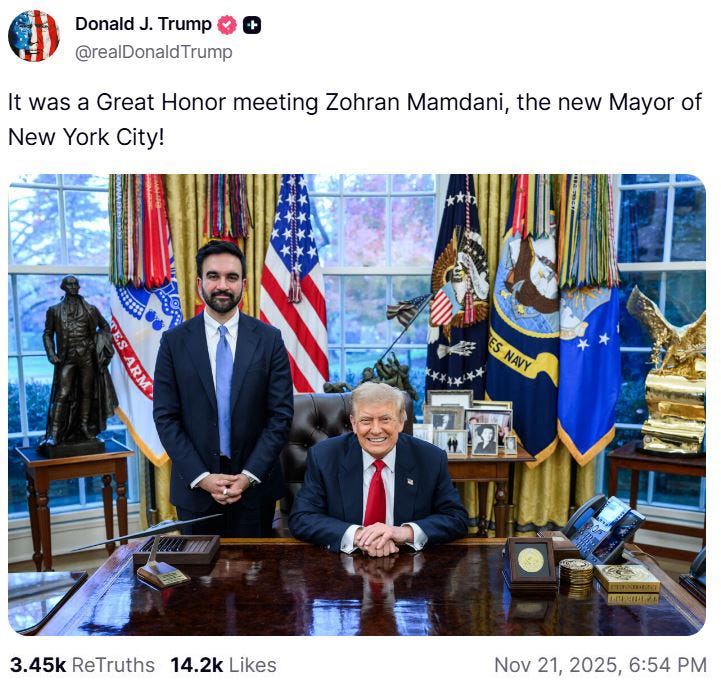
Two weeks after Mamdani’s win last November, the two New Yorkers held a chummy Oval Office photo op. During a private meeting, Mamdani reportedly pushed Trump to support a historic housing project backed by federal grants. As the cameras snapped photos, Trump said Mamdani would make a great mayor, and Mamdani described their shared commitment to the city.
 |
Ten months later, the vibes have shifted: With ICE operations growing in New York, Mamdani announced this week that both the city and New York state were joining a coalition of twenty-two states and cities, including Chicago, Seattle, and San Francisco, to sue the federal government over an immigration-related rules change.
The change involves something called “public charge”—in the sense of ‘a charge upon the public.’ It’s a statutory category that immigration officials can use to reject a person’s application for a green card, a visa, or entry into the United States, if it seems like the person might be a burden or a liability to the public.
The Biden administration in 2022 set out a new rule for how Citizenship and Immigration Services would make such decisions. Under the new approach, officials were to mostly focus on whether potential immigrants would be dependent on cash-assistance programs like Temporary Assistance for Needy Families or Supplemental Security Income.
Late last year, the Trump administration announced it would rescind the Biden-era rule, replacing it with . . . nothing. The change, which goes into effect today, reverts to the vague statutory concepts the Biden administration had tried to clarify and instructs USCIS to factor in many benefits previously not considered when judging whether people should be categorized as public charges.
More vagueness around what constitutes a public charge (and casting a wider net for benefits that could make someone a public charge) means USCIS and consular officers have greater discretion to deny visa or green card applications. Which is, of course, the point.
The change is one of the many examples of the Trump administration’s tried-and-true approach of bureaucratic cruelty. The administration claims these laws and policies will curb illegal immigration, but in reality they will hurt legal immigrants as well as permanent residents and U.S. citizens, including children.
The lawsuit brought by New York City and others alleges that the new rule violates the Administrative Procedure Act because the Trump administration “fail[ed] to reasonably explain [its] drastic change in position, speculating without supporting evidence” that there was a problem with the 2022 rule.
The practical impact of the Trump administration policy is that it significantly expands how immigrants and mixed-status families can be punished for using public benefits by creating ambiguity. The Department of Homeland Security refuses to define what constitutes a public charge, but says its officers will make subjective determinations based on what benefits are used and the “totality of circumstances.” This totality will “include any benefits for which there is a means-test,” Brookings explains, “including but not limited to Medicaid, the Children’s Health Insurance Program, SNAP, housing assistance, Head Start and child care, school meals, WIC benefits, refundable tax credits.”
In short, immigration officers will be able to use virtually any public benefits received by a person for any period of time as evidence against that person’s immigration application—even if they were benefits used by a family member, which includes U.S. citizens.
If power is being used cruelly, the least a free society can do is refuse to let it happen unseen. Our coverage of the Trump administration’s abuses is made possible by the support of our Bulwark+ members. We would love for you to become a member, and join the side you’re already on.
“A Chilling Effect”
Mamdani and the coalition suing the Trump administration say fears and confusion over accepting public benefits will lead some immigrants to disenroll from programs that serve them, and others not to enroll in the first place, even if they’re eligible.
Speaking at a press conference on Monday, Mamdani said the data is clear that “denying people services does not erase their need, it compounds it,” and that the Trump administration was seeking to make “hungry New Yorkers hungrier” and “poor New Yorkers poorer.”
“The toll of this new rule cannot be overstated,” Mamdani added. “It is estimated that up to 4 million people from across the country could unenroll from their health care alone, including up to 1.8 million children. None of this is abstract. People could die.”
Mamdani said shutting off the valve of public benefits for these people could lead to a 10.6 percent increase in the rate of premature death in immigrant communities within five years. He cited studies by the city’s Department of Health and Mental Hygiene.
Perversely, as a Brookings report notes, Mamdani’s warnings echo the federal Department of Homeland Security’s own projections. DHS has calculated that an annual reduction of $13.05 billion in federal and state transfer payments “attributable to disenrollment or nonparticipation” in Medicaid, the Children’s Health Insurance Program, the Supplemental Nutrition Assistance Program, Temporary Assistance for Needy Families, Supplemental Security Income, Federal Rental Assistance, the WIC Program, and others, will result in “an estimated 1.3 million persons disenr