| Welcome, Weekenders! In this newsletter: |
| • Exclusive new list! Introducing Tech’s 50 Most Influential People |
| • Plus, Recommendations—our weekly pop culture picks: “Embedded: Where Is Austin Tice?,” “Valley of Death” and “Hope” |
| |
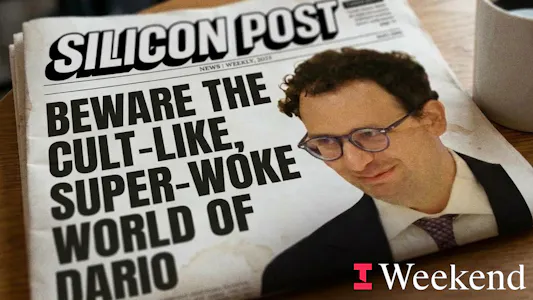
| Honestly, I almost feel a little sorry for Dario Amodei. That essay-writing, sweater-loving nerd is getting the treatment normally meted out to grim-eyed murderers and sex-romping celebrities. |
| Put another way: The New York Post has discovered him in earnest. Well, him and effective altruism. By my count, the outlet has published more than a dozen stories mentioning Amodei or effective altruism in the past week. One had a headline describing Anthropic’s staff as “cult-like,” the same label it had applied a while back to effective altruists in general. (C’mon, fellas! Invest in a thesaurus.) |
| A second Post headline gave prominent attention to President Donald Trump’s recent criticism of Amodei’s suggestion for an AI industry slowdown: a “SICK conspiracy,” Trump called it, the capital letters all his. A third headline described METR, the AI research outfit Amodei says he’ll use to independently assess his company’s safeguards, as a group of “super-woke globalists.” And a fourth headline on an editorial board piece thundered out: “Beware the ‘effective altruists.’” |
| Eeesh. I wonder what would excite the mouth breathers at the Post more: another Amodei doom dump—or JonBenét Ramsey’s parents finally saying they did it? |
| Sure, Amodei has steadily attracted more and more—and more—media attention over the past five months, and so has effective altruism, which obviously got a lot of attention in the Sam Bankman-Fried days, too. But there’s something about watching Amodei and the EA set get turned into daily tabloid fodder right now that strikes me as an important marker of where the broader world’s conversation about AI stands. It’s loud, wacky as heck—and candidly, I worry it’s a precursor to something darker. |
| I sat here trying to wrap my mind around it, and I started to get a headache like the one that sits at the bottom of a bourbon bottle. The Post is channeling a populist antipathy for Amodei and effective altruists that’s rooted in a dislike for their AI apocalypse talk. Yet at the same time there’s populist concern that AI may very well invite Armageddon: A recent survey by Politico found that 63% of U.S. adults believe AI could eventually destroy the world. So in sum, there’s widespread concern about destructive AI—and scorn for the people who want everyone to focus on it. As I said, it’s wacky. |
| Put aside AI catastrophe for a second. The bigger reason people dislike Amodei and the effective altruists is because they perceive them as the influential, liberal elite. It’s this potent derision that really animates the Post, and I find it unsettling. It’s the same type of addled, conspiracy-minded resentment that makes people still believe in Pizzagate and rigged voting machines. |
| What I find especially facile is the assumption that effective altruists and those who share their beliefs actually do wield gigantic influence over AI. I’d argue that they actually don’t. Articles by the Post and other outlets portray effective altruists as a wide cabal, but they only ever really mention the same three people over and over: Amodei; his sister, Daniela; and Facebook billionaire Dustin Moskovitz. |
| Look, three people simply do not make an all-powerful cabal! I keep thinking about that disconnect between assumption and reality—probably because I’ve devoted enormous thought lately to considering who really does have clout in AI as we put together our debut list of Tech’s 50 Most Influential People. Yes, the Amodei siblings are on the list, and they’re the No. 1 and No. 2 figures at a gigantic company. But that’s…it. Not a single other person on our list belongs to the effective altruism crowd. |
| I don’t write this as a passionate Amodei fanboy, nor as someone who finds effective altruism especially appealing: It’s an ideology that can be channeled into single-minded glumness when someone swallows the whole pill bottle and commits fully to it. A conversation with an effective altruist about the future is about as much fun as discussing foie gras with a vegan. It’s just that the concerns about Amodei and the effective altruists are beginning to strongly remind me of previous worries about lizard people taking over Congress. |
| Perhaps I’m making too much of those Post stories I mentioned. Still, with nearly 100 million readers a month, the Post is big enough to inspire other outlets to follow its lead, covering Amodei and AI with a sensationalism rooted in gassed-up anxiety and quarter-truths. Amodei’s the guy getting tarred and feathered today. It’d be a mistake to assume he’ll be the last.—Abram Brown (abe@theinformation.com) |
| |
|
 |
|
| The technology industry runs on influence. Its presence shows up in big, attention-grabbing moments—but much of it is dispersed in cloudy mystery, producing subtle ripple effects missed by casual observers. The CEOs of the largest companies certainly have clout. But so do a host of behind-the-scenes investors, renegade founders and rising-star executives. |
| These are the people we at The Information think are most likely to influence the industry over the next decade. For more on how we created this list, here’s an extended explanation of our methodology. |
| |
 |
| Listening: “Embedded: Where Is Austin Tice?” |
| In 2012, Austin Tice, a former U.S. Marine who’d decided to try his hand at freelance foreign correspondence, went MIA in Syria. And he’s still missing 14 years later. His mother clings to hope that he’s alive. Every president since Barack Obama has vowed to bring him back. But if he has somehow survived, why hasn’t he surfaced since the Assad regime fell in 2024? Josh Baker and Sara Obeidat, a pair of veteran Middle East reporters, set out to try to answer that question in “Embedded: Where Is Austin Tice?,” an NPR-BBC joint production. |
| They’re well sourced and determined, and by episode 2, they’re in an infamous prison retrieving never-before-seen files that the Syrian government kept on Tice. This involves a little bit of Bond-esque derring-do from Baker, who risks a five-story fall from a window ledge to get from one barricaded room to another. Additionally, I appreciated that they could display obvious empathy for Tice’s loved ones and stop short of lionizing him. He was clearly ill prepared to be in Syria. It was his very first attempt at freelance reporting. His military experience had emboldened him to go and made him a popular talking head for TV networks looking for on-the-ground analysis, but it also made many Syrians think he was in actuality an American spy posing as a journo.—Abram Brown |
| Reading: “Valley of Death” by Sharon Weinberger |
| A year or so before Donald Trump’s reelection, Sharon Weinberger, then national security editor for The Wall Street Journal, visited the offices of an unnamed but prominent venture capital firm. Yes, the tech world invasion of Washington that has happened in the second Trump administration was still far in the future, but even then, Weinberger had begun noticing how Silicon Valley and Washington were intersecting more than they had in the past—particularly when she looked at the venture capital going to defense tech startups. |
| At the VC firm, Weinberger asked the investor why the private sector would invest in technology like hypersonic weapons given the astronomical costs and uncertain business models. “I honestly don’t care about the product,” replied the investor. “It has nothing to do with the tech.” Instead, he argued, the success of the products—and his own returns—depended more on government relationships and lobbying, which was increasingly a strength for Silicon Valley firms. |
| By Weinberger’s own account, she found herself thinking often of that investor’s sentiment as she wrote “Valley of Death,” an account of how Silicon Valley strayed from its Cold War national security roots before returning to the corridors of the Pentagon in recent years. |
| Weinberger offers an engaging history, with details of untold episodes in the intertwined relationships between Silicon Valley and Washington, like Steve Jobs’ brush with the CIA. As she goes along, she illustrates how the tech titans of defense contracting such as Elon Musk, Palantir’s Alex Karp and Anduril’s Palmer Luckey have strong-armed their way into the staid field. And she details how they’ve been adept at talking up their companies, though their products haven’t always lived up to the hype—especially in Ukraine. |
| Weinberger sees shortcomings in their “techno-optimism,” as she puts it. She thinks it could lead to ruinous scenarios not only for the firms’ financial backers but also for the U.S. armed forces at a time of heightened conflicts and supply chain constraints. Weinberger is a measured and well-traveled chronicler of the Silicon Valley arms race, raising the same concerns I’ve heard some investors share out loud. |
| By the time she ends with President Dwight Eisenhower’s timeless warning of the dangers of the military-industrial complex, or “subordinating national security to private interests,” it’s clear why the current moment of defense tech feels deeply familiar.—Leo Schwartz |
| Watching: “Hope” |
| Up near the 38th parallel, the fictional South Korean hamlet of Hope Harbor—the setting of director Na Hong-jin’s latest movie, “Hope”—exists in a state of permanent paranoia, with North Korea not very far away. Signs implore residents to “REPORT SPIES” and “PROTECT THE NATION AGAINST INFILTRATION.” And everyone seems to have a stash of automatic weapons hidden away at home, much to the irritation of the town’s chief constable, Bum-seok (Hwang Jung-min). But it doesn’t seem likely that communist commandos are responsible for the body of a mutilated steer just outside of town. A bear, maybe—or a tiger? No, something much, much bigger. |
| Na, clearly a devotee of the Spielbergian school of patient dread, waits almost an hour before getting that giant alien beastie on screen. Kudos to him. As is often the case, the buildup makes the payoff sweeter. Once the creature finally does smash its way fully into frame, “Hope” shifts into overdrive, with a number of genuinely exciting set pieces and chase sequences: I emphasize the plural there because, unfortunately for Bum-seok and his more able deputy, Sung-ae (Hoyeon), the town is threatened by an entire pack of these lanky-limbed E.T.s. They’re darn difficult to take down, and they play possum pretty well. And since “Hope” takes place sometime in the pre-cellphone past, backup is not a text message away. |
| The set decoration of ruined Hope Harbor looks fantastic. And the mayhem is captured well through the camerawork of Hong Kyung-pyo, who also did “Parasite” as well as “Snowpiercer.” His efforts mitigate the letdown of the CGI effects: It’s a puzzler that the movie can rank as the most expensive Korean film ever and not have managed better. Honestly, though, the lackluster CGI was far from bad enough to dim my enjoyment. I trust the aliens will get jazzed up when Na returns for his already greenlit sequel.—A.B. |





 Gift Subscription