| | In tonight’s edition: A peek at Anand Giridharadas’ new book, and a Brazen investment.͏ ͏ ͏ ͏ ͏ ͏ |
| |  New York New York | Hollywood |  London London |
 | Media |  |
| |
|
 - Man in the mirror
- Mixed Signals
- Emanuel’s memoir
- Bullish Brazen
- AI-scaled ads
- Censorship polling
|
|
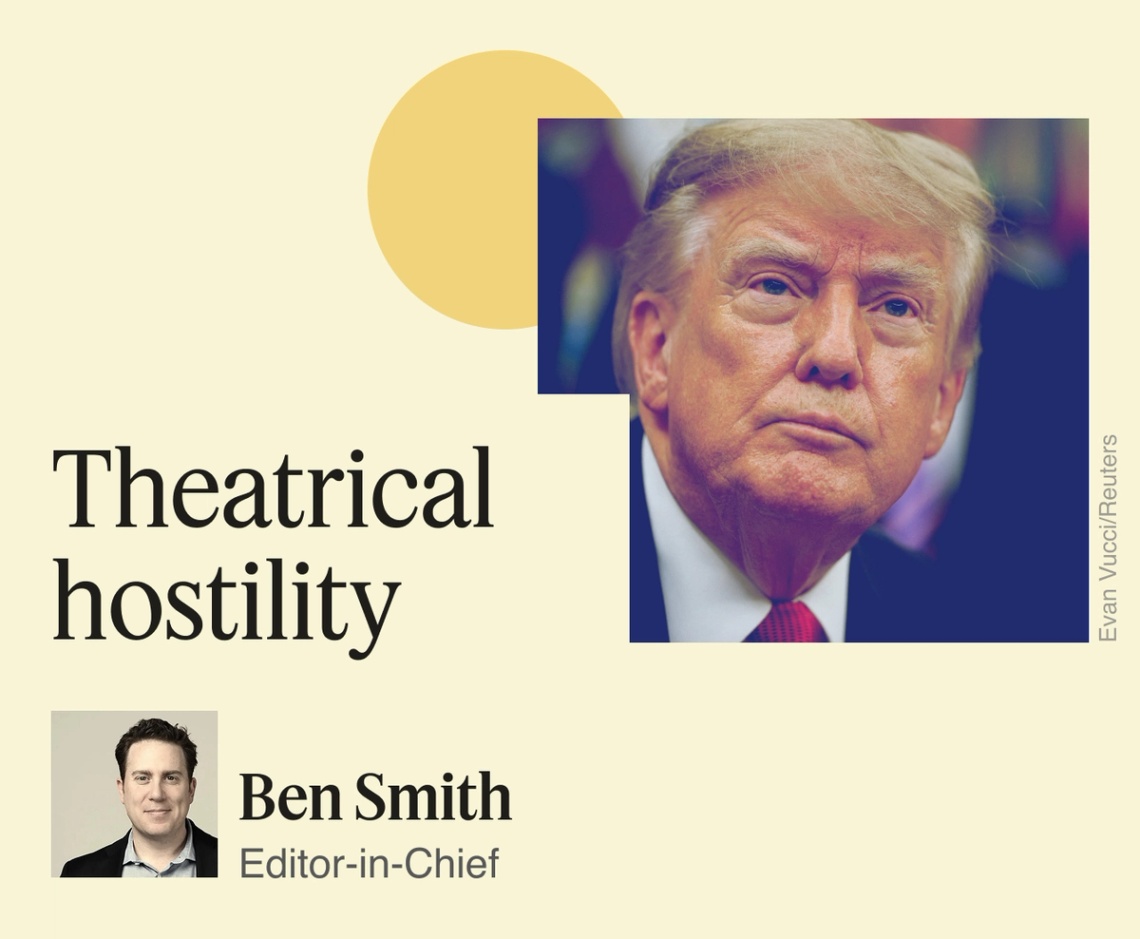 There are ways in which Donald Trump is unlike every other political figure in American history, and ways in which he’s like all of them. His theatrical hostility to many of the journalists who cover him is new. Its arc is familiar: A newly elected president thinks he can get away with talking solely to friendly media, who are themselves riding his victory to big audiences and influence. Then governing gets complicated. Some of that friendly media turns critical, and the rest gradually shrinks from the grim and boring role of playing attack dog for the party in power. Persuasion and influence run again through talking to an adversarial press. You can either acknowledge that or thrash around helplessly. The Iran war, in particular, was always going to be unpopular — but has the US government ever failed more fully to persuade its citizens? Last week, Trump went back to the old playbook, banning CNN, MS NOW, and Politico from the White House. The move was greeted by a mixture of shrugs and solidarity: Jacqui Heinrich, the Fox News reporter who leads the White House Correspondents’ Association, immediately defended her ousted colleagues. It’s hard to see how this helps the White House. Sometimes, the laws of gravity even apply to Trump. Also today: Max is off this week, on a tour of Europe’s smallest media markets. So what follows has a bit more of my musings, and only one scoop. |
|
‘Rashomon’ on the F Train |
 Penguin Random House Penguin Random HouseAnand Giridharadas’ wonderful first book, The True American, told the story of a Pakistani-born gas station attendant in Texas who was shot in the face by a white supremacist — only to then try and save his attacker from the death penalty. Giridharadas may be best known these days as a progressive political commentator, but his new book, Man in the Mirror, goes back to those roots with the tale of the subway confrontation between Jordan Neely, a homeless man with mental illness, and the former Marine Daniel Penny, who was acquitted of killing him. The book is a model of a kind of journalism you don’t see much of, journalism that shows compassion for everyone involved. He takes a stab at explaining this political moment through each man’s supporters: “They shared the sense of being undefended. They shared the sense that the cavalry was not coming. They shared the sense that the system was rigged, corrupted, driven by forces and factors that didn’t serve them. They shared the sense that the old ways of achieving the world you wanted — marching, voting, asking nicely — were dying,” he wrote. “They shared the sense of pessimism about anyone doing anything, though, and therefore they shared the sense that sometimes the person to do something was you.” |
|
Pangram chief on ‘Mixed Signals’ |
 Will human touch become the scarcest thing on the internet? Pangram CEO Max Spero thinks so. On this week’s episode of Mixed Signals, Spero joins Max and Ben to explain how his AI detection tool actually works, and why he thinks the escalating cat-and-mouse game between detectors and “humanizers” is a fight worth having. They ask Spero how Pangram can already distinguish Claude from ChatGPT, why he built a humanizer internally and refuses to release it, and what it would actually take for a fine-tuned personal AI to fool his model. |
|
Don’t need Pangram for this one |
 Manuel Orbegozo/Reuters Manuel Orbegozo/ReutersAri Emanuel is the main character in the recent history of Hollywood, and so his new memoir will be the talk of the town this fall. An excerpt in The Wall Street Journal resolves one question lingering over the project: Was Emanuel actually going to participate in the writing? The voice is pretty much the super-agent’s own (captured, sans quote marks, by ghostwriter J.R. Moehringer): “Doesn’t matter, David Geffen says when I seek his advice. Doesn’t matter? David, what the f—?” You get the idea. “So frenetic and so aggressive and so scattered — I guess he really did write it,” one client remarked to me. There’s also a real insight into the media business buried in the one-sentence paragraphs: “Our main product, talent, isn’t like other products that people sell. It’s not like furniture or jewelry or cars; it comes entangled with thin skins, volatile tempers, melodrama galore — our whole business model is built on emotion.” |
|
 Brazen BrazenBrazen, the investigative studio launched in 2021 by former Wall Street Journal reporters Bradley Hope and Tom Wright, has raised a new round of financing as much of the industry is moving in the opposite direction. Hope and Wright, the producers of narrative podcasts — including The Sound, an investigation of Havana Syndrome; the wild Navy corruption tale Fat Leonard; and a new series, The Tell, on the former Supreme Court litigator and high-stakes poker player Tom Goldstein — raised $2.6 million from a Singapore-based family investment firm, the Lotus Group. “We built Brazen so we could back our own judgment about a story,” Hope said. “When we find something worth pursuing, we can start reporting and give it the time it needs.” Brazen is trying to build a business developing journalistic content for film, TV, and other formats, with projects including adapting their 2018 blockbuster book Billion Dollar Whale. “Original reporting is the foundation of Brazen’s business,” says Lotus executive chairman Nirmal Singh. “We’re backing them to build a company that can keep doing that over the long term.” |
|
 Screenshot via @itsemilyhiggins Screenshot via @itsemilyhigginsOur Semafor Tech colleague J.D. Capelouto reported last week on Avail, an AI startup that promises to allow content creators and brands to generate slightly different versions of pre-recorded ads tailored to specific regions or audiences. CEO Chris Giliberti is pitching his company’s latest tool, called creatorAPI, as a (relatively) human-powered response to the rise of fully synthetic AI-generated influencers. The tool will let creators “scale themselves like software,” he said. Giliberti is anticipating some controversy. “There’s this purity that people expect from creatives, like they’re always the last people that are allowed to adopt productivity tools,” he said. “I just think it’s really unfortunate that software engineers are able to crank out 10 times more code with [AI] tools and that’s palatable ... but the second a creator adopts a tool like this, they’re shamed for it.” |
|
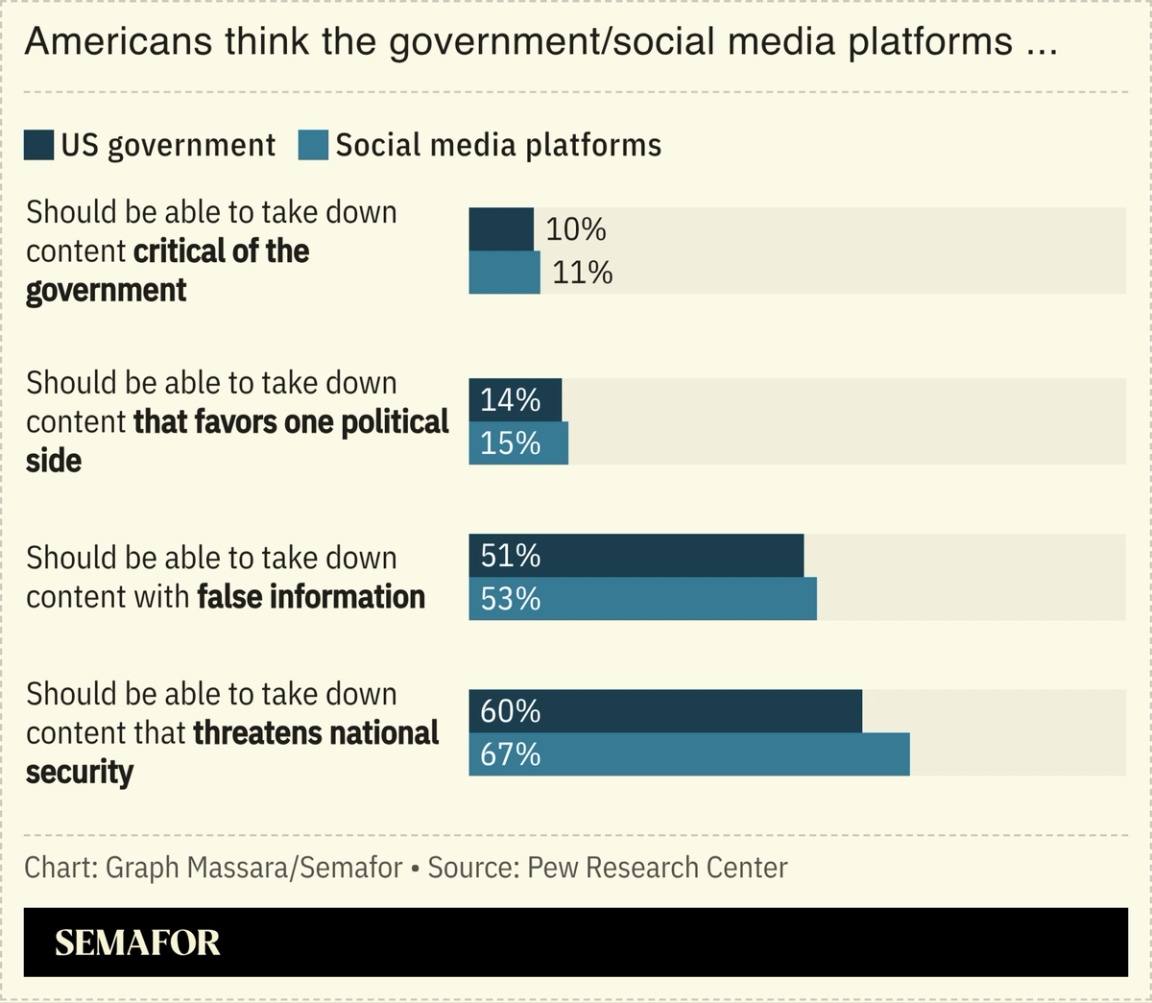 Americans believe social media platforms and government regulators should have similar obligations to protect speech, according to a deep-dive from Pew into press freedoms. A slight majority (53%) said they believe it’s more important to prevent inaccurate reporting than to allow entirely unfettered press freedom. Partisan censorship, though, remains unpopular. Most respondents said that both government regulators and social media companies should be able to delete content that contains falsehoods (≥51%) or threatens national security (≥60%). But stronger majorities said it should be unacceptable to take down news stories or posts just because they are partisan (≥72%) or critical of the government (≥71%). — Graph Massara |
|
NYT: A CBC style guideline advising journalists not to call the 9/11 attacks “terrorism” without attribution so outraged FBI Director Kash Patel that he temporarily cut back his agency’s cooperation with the Royal Canadian Mounted Police, report Maggie Haberman, Jane Bradley, Jonathan Swan, Adam Goldman, and Matina Stevis-Gridneff. FT: OpenAI copied millions of news articles to make its technology worth “gazillions,” according to a filing in The New York Times’ lawsuit against the company, George Hammond and Stephen Morris report. WaPo: Video game industry reporter Gene Park gets Hideo Kojima’s side of his breakup with Sony. Silver Bulletin: Nate Silver’s models (and prediction markets’) are much more optimistic about Democrats’ chances for retaking the Senate than some professional race-raters’. |
|
 - One question regarding The New York Times’ celebrity-studded shock-and-awe 175th birthday party last week: Why celebrate such a random anniversary? One answer is that the Times is doing great and has to spend all that revenue on something. Another is that the Times’ 150th was planned for mid-September 2001, and after 9/11, never took place.
- China is a big story, but US-based media continues to struggle to sustain audience interest: Wired just shut down its Made in China newsletter.
- After a week of incremental developments in the WBD-Paramount antitrust drama — and as David Ellison increasingly telegraphs that he could make good on his threat to pull his studio out of Hollywood — the negotiations between state attorneys general, as personified by California’s Rob Bonta, and Paramount appear to be reaching the endgame. In-person anti-merger protests are planned as far afield as Oakland and Manhattan.
- Semafor’s Ashley Gold decoded the meme war brewing on X as the Trump administration zeroes in on effective altruism as a boogeyman.
- Kai-Fu Lee, the Beijing-based CEO of 01.AI, thinks the scenario much of Hollywood has been bracing for — AI-powered studios leveraging the tech to cut costs, enhance actors, or speed up production — is only going to be “a little bit of a moat” against incursion by “AI-native” companies, like the ones now churning out microdramas in China. In a conversation with Semafor’s Andrew Edgecliffe-Johnson and Reed Albergotti, Lee compared the big studios’ strategy with the argument that Blockbuster could stay competitive with Netflix: “The game will be over in a couple of years.”
- It’s been a weird couple of weeks for San Francisco’s local media: The CEO of the SF Standard, the splashy news site scooping up reporting talent — and raising
|
|
|


