
|
 |
| ||

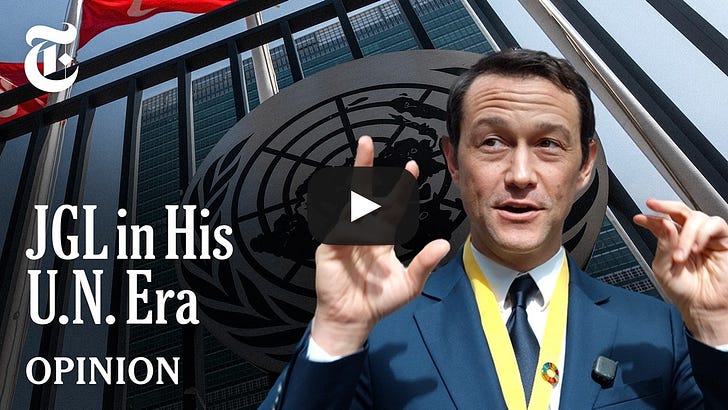
I went to the United Nations. The New York Times had questions.
As the UN’s Global Ambassador for Human-centric Digital Governance, it was an honor to participate in this year’s United Nations General Assembly.
|
| |||||||||||||||


Link to the full article on the New York Times.
I’ve spent most of my life as a storyteller, making movies, TV and other what-have-you’s that try, in one way or another, to capture what it means to be human.
Storytelling is perhaps humanity’s defining technology, a way of transmitting not just information but also inner life. It’s how we understand each other’s love, jealousy, ambition, grief, fear, longing. And while technology changes over time, human universals do not.
But will that always be true? Especially as technology gets more and more powerful?
Over the last decade or so, I’ve become increasingly fascinated — and increasingly concerned — with the ways technology is changing not just how we tell stories, but how we communicate, how we cooperate, even how we think.
The more I learn about the technology we call artificial intelligence, and the more I understand the enormous impact it’s already having on what it means to be human, the more compelled I feel to use my abilities as a storyteller to help others understand what’s at stake, and to advocate for the kind of global cooperation this moment demands.
I’ve been listening to and learning from all kinds of experts in the field: technologists, policy wonks, money makers and truth seekers. I’ve been making videos, giving talks — I’m even directing a movie I co-wrote about this subject for Netflix. Earlier this year, the United Nations (bless them) took notice of all this and offered me an official position: Global Advocate for Human-Centric Digital Governance.
A couple of weeks ago, I joined the international community at the United Nations General Assembly, where one of the big topics this year, as you might imagine, was A.I. governance. It was an enormous honor to get to participate in the global discussion around this topic. And yes, I made a video for Times Opinion about my experience to help tell the ongoing story — and attempt to answer five questions on A.I. that might be on your mind
Questions from the New York Times:
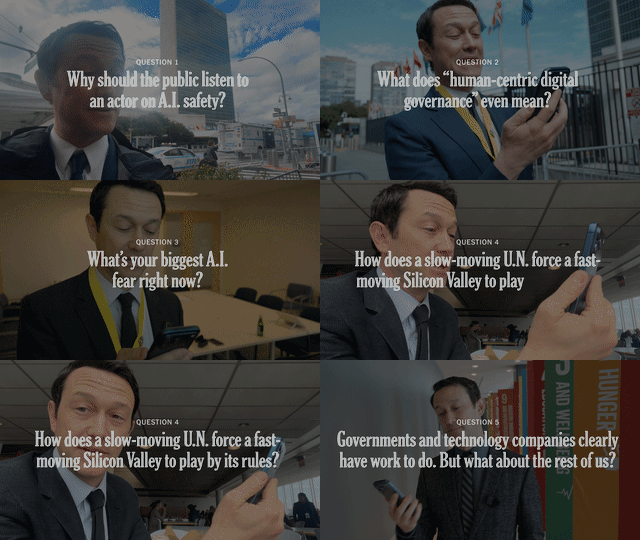
Why should the public listen to an actor on AI safety?
My answer:
Very fair question. Why listen to an actor? Don’t listen to an actor. You should read Human Compatible by Stuart Russell. Go look up Yoshua Benjio. Read posts by people who work in alignment and safety and policy. You don’t want to read all those things? Well I did! So, you know, if you want to listen to me, that’s a shortcut. What we don’t want is a bunch of people confused or apathetic while these very fast moving businesses, design the future by themselves, just in the interest of their own profits.
A lot of what needs to happen, I think, has to do with communication. Which is ultimately kind of what acting or filmmaking is.
What does "human-centric digital governance" even mean?
My answer:
Even mean? What does that even mean? Human centric digital governance. Sort of a mouthful. It just means that digital technology should be governed by people and for people. "AI" is nothing but algorithmically recombined, human-produced data. It’s humans.
Calling it artificial intelligence sort of de-centers humans. It offers this kind of magical, fictitious character, this "AI" that we’ve seen in various sci-fi movies, but really, really all it is, is us. It’s us.
What’s your biggest AI fear right now?
My answer:
At the risk of annoying the New York Times, I would object to that question just because reducing these concerns into kind of one soundbyte of fear... that’s one of the problems.
To me saying, I’m scared that AI could exterminate all of humanity, that doesn’t really get at the substance of the concern. There is real validity to that concern. But that’s not the thing that really worries me.
The thing that worries me is a lot more complicated and a lot more boring to talk about, because it’s a lot more dense. The decline of democracy, the decline of human empathy.
These companies are betting on the notion that they’re going to take over the entire economy. That would be totalitarianism and that would be really bad.
Simultaneously, these models are being trained to kind of hijack your intimacy, to make friends with you, to get you to fall in love with it.
We shouldn’t be scared of an AI. We should be concerned about the people building AI.
How does a slow-moving UN force a fast-moving Silicon Valley to play by its rules?
My answer:
To be honest, this is one of the things that I have found sort of daunting or troubling.
I don’t know the answer.
I think if it does take, say, seven years, just say, for the UN to put together an internationally agreed upon regulatory framework for AI, then seven years from now, we’ll be glad that we started now.
Governments and technology companies clearly have work to do. But what about the rest of us?
My answer:
Well... The midterms are coming up.
We Americans have an extra responsibility because the frontier of this technology is being developed in our country. So a lot of the world, and I’m hearing from them here at the UN, a lot of the world is looking to see what we as Americans are going to do. What’s the signal that we are going to send our government in these next elections? And I hope we send a very clear one.
|